In today’s highly competitive digital landscape, businesses generate enormous amounts of data every second. Customer interactions, website visits, sales transactions, support tickets, marketing campaigns, and operational activities all produce valuable information. However, collecting data alone isn’t enough. The real advantage comes from understanding what that data means—and more importantly, what it can predict.
Organizations that embrace predictive analytics are better equipped to anticipate customer behavior, reduce operational risks, optimize resources, and make smarter business decisions backed by data instead of assumptions. As digital transformation accelerates across industries, predictive analytics has become one of the most valuable technologies for organizations seeking sustainable growth.
Businesses looking to modernize their operations often combine predictive analytics with scalable software solutions, cloud platforms, and intelligent applications. Modern custom software development services, such as those offered through platforms like Technobot System, enable organizations to integrate predictive models directly into their existing business workflows for better decision-making.
This guide explains how predictive analytics works, why it matters, its business applications, implementation strategies, common challenges, and future trends that every organization should understand.
What Is Predictive Analytics?
Predictive analytics is the process of using historical data, statistical algorithms, artificial intelligence (AI), machine learning (ML), and data mining techniques to forecast future events and outcomes.
Instead of simply analyzing what happened in the past, predictive analytics answers questions such as:
- What is likely to happen next?
- Which customers are most likely to make a purchase?
- Which equipment is likely to fail?
- Which marketing campaign will perform best?
- Which products will experience increased demand?
Rather than relying on intuition alone, businesses can make informed decisions supported by data-driven insights.
Why Predictive Analytics Helps Businesses Make Better Decisions
Business decisions often involve uncertainty. Predictive analytics significantly reduces that uncertainty by identifying patterns that humans may overlook.
Organizations use predictive analytics to:
- Forecast sales
- Improve customer experience
- Reduce operational costs
- Detect fraud
- Optimize inventory
- Improve employee productivity
- Manage financial risks
- Personalize customer interactions
Instead of reacting after problems occur, companies become proactive.
For example, an online retailer can predict seasonal demand weeks in advance, allowing inventory managers to prepare stock before shortages occur.
How Predictive Analytics Works
Predictive analytics follows a structured workflow.
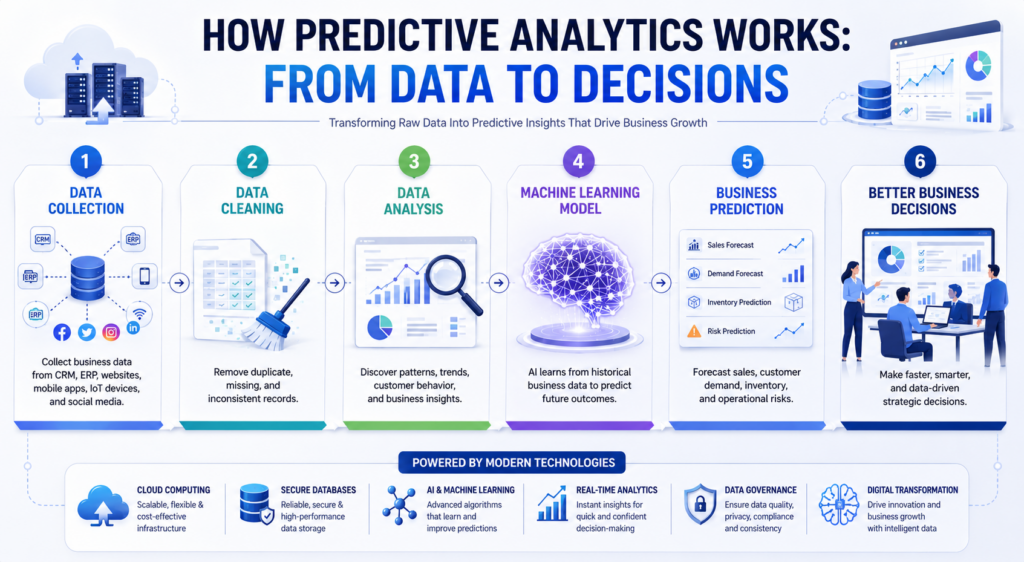
1. Data Collection
Businesses collect data from multiple sources such as:
- CRM systems
- ERP software
- Websites
- Mobile applications
- Social media
- IoT devices
- Sales platforms
- Customer support systems
The more reliable the data, the more accurate the predictions.
2. Data Cleaning
Raw business data usually contains:
- Missing values
- Duplicate records
- Incorrect entries
- Inconsistent formatting
Cleaning the data ensures models generate reliable predictions.
3. Data Analysis
Data scientists identify:
- Trends
- Patterns
- Correlations
- Customer behaviors
- Seasonal changes
This stage helps determine which variables influence future outcomes.
4. Model Building
Machine learning algorithms are trained using historical data.
Popular predictive models include:
- Decision Trees
- Random Forest
- Neural Networks
- Logistic Regression
- Linear Regression
- Gradient Boosting
- Time Series Forecasting
Each model serves different business requirements.
5. Prediction
Once trained, the model predicts future events using new incoming data.
Examples include:
- Future revenue
- Customer churn probability
- Product demand
- Equipment failures
- Marketing conversion rates
6. Continuous Improvement
Predictive models improve over time.
As new business data becomes available, models are retrained to increase prediction accuracy.
Key Technologies Behind Predictive Analytics
Predictive analytics combines several modern technologies.
Artificial Intelligence
AI enables systems to identify complex relationships within large datasets without explicit programming.
Machine Learning
Machine learning continuously improves prediction accuracy as additional data becomes available.
Big Data
Large datasets provide richer insights and more accurate forecasting.
Cloud Computing
Cloud platforms enable organizations to process massive datasets efficiently without investing heavily in on-premises infrastructure.
Data Visualization
Interactive dashboards help decision-makers understand predictions quickly.
Tools such as Power BI, Tableau, and Looker make predictive insights easier to interpret.
Business Benefits of Predictive Analytics
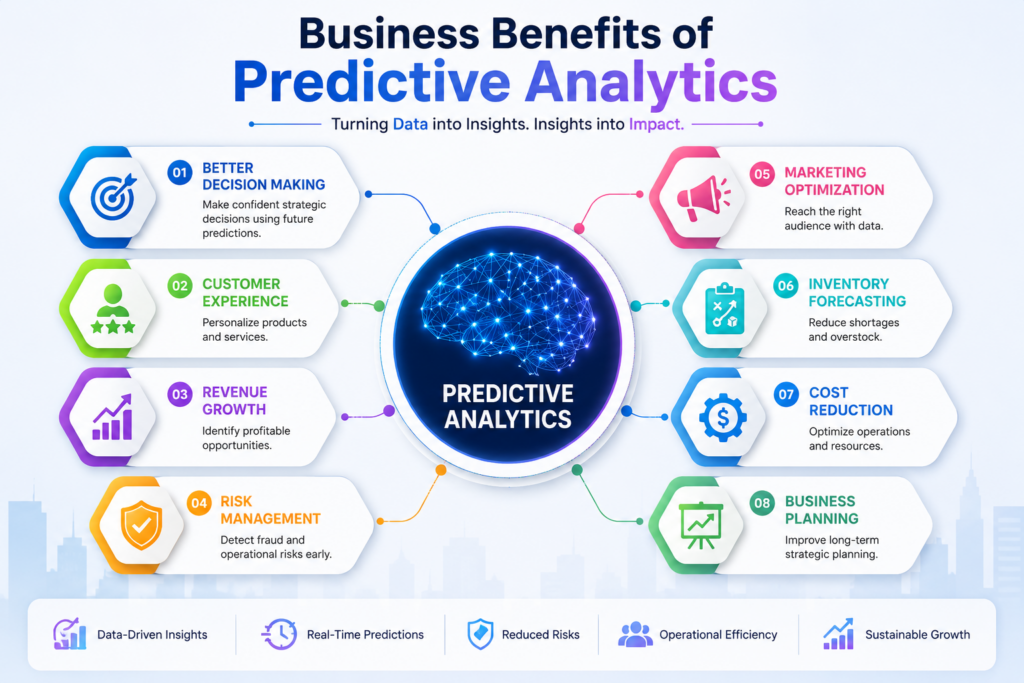
Better Strategic Planning
Predictive insights help executives make long-term decisions with greater confidence.
Instead of relying on assumptions, organizations can estimate future demand, customer growth, and financial performance.
Improved Customer Experience
Understanding customer behavior allows businesses to deliver personalized experiences.
Examples include:
- Product recommendations
- Personalized offers
- Customized emails
- Dynamic pricing
- Customer retention campaigns
Companies using predictive customer analytics often achieve higher engagement and improved customer satisfaction.
Smarter Marketing
Marketing teams can identify:
- Best-performing channels
- High-value customer segments
- Purchase likelihood
- Campaign success probability
Predictive marketing improves ROI by targeting the right audience at the right time.
Organizations exploring digital transformation strategies can also gain valuable insights from technology-focused resources available at Technobot Systrm Blog, where topics such as AI, cloud computing, and software innovation complement predictive analytics initiatives.
Reduced Operational Costs
Predictive analytics helps organizations:
- Reduce waste
- Optimize staffing
- Improve scheduling
- Lower maintenance costs
- Improve resource allocation
Operational efficiency directly improves profitability.
Better Risk Management
Businesses can identify risks before they become serious problems.
Examples include:
- Financial fraud
- Credit defaults
- Cybersecurity threats
- Supply chain disruptions
- Compliance risks
Early detection minimizes losses.
Increased Revenue
Companies that understand customer behavior make better sales decisions.
Predictive analytics helps identify:
- Cross-selling opportunities
- Upselling opportunities
- High-value customers
- Purchasing trends
The result is improved revenue growth.
Industry Applications of Predictive Analytics
Healthcare
Healthcare providers use predictive analytics for:
- Disease prediction
- Patient risk assessment
- Hospital resource planning
- Readmission prediction
- Treatment optimization
Retail
Retail businesses forecast:
- Product demand
- Customer preferences
- Inventory levels
- Pricing strategies
Predictive analytics minimizes overstocking and stock shortages.
Banking and Finance
Financial institutions use predictive analytics for:
- Fraud detection
- Credit scoring
- Investment forecasting
- Loan approval
- Risk analysis
Manufacturing
Manufacturers use predictive maintenance to detect equipment failures before breakdowns occur.
Benefits include:
- Reduced downtime
- Lower maintenance costs
- Improved productivity
- Increased equipment lifespan
Logistics
Logistics companies predict:
- Delivery times
- Traffic conditions
- Fuel consumption
- Warehouse demand
Optimized routes reduce transportation costs.
E-commerce
Online businesses use predictive analytics for:
- Product recommendations
- Cart abandonment prediction
- Dynamic pricing
- Customer lifetime value estimation
- Personalized shopping experiences
Real-World Examples of Predictive Analytics
Netflix
Netflix predicts which movies users are likely to watch based on viewing history and preferences.
This personalized recommendation system improves user engagement.
Amazon
Amazon forecasts product demand, manages inventory efficiently, and delivers personalized recommendations.
Its predictive systems improve customer satisfaction while reducing logistics costs.
Airlines
Airlines use predictive analytics to:
- Optimize ticket pricing
- Predict maintenance needs
- Improve flight scheduling
- Manage fuel consumption
Insurance Companies
Insurance providers predict claim risks using customer behavior and historical claim data.
This enables more accurate premium calculations.
Predictive Analytics vs Traditional Business Intelligence
| Traditional Business Intelligence | Predictive Analytics |
|---|---|
| Explains past events | Predicts future outcomes |
| Historical reporting | Future forecasting |
| Reactive decisions | Proactive decisions |
| Static dashboards | Dynamic prediction models |
| Basic trend analysis | AI-powered forecasting |
Both approaches are valuable, but predictive analytics enables organizations to prepare for future opportunities instead of simply reviewing historical performance.
Challenges in Implementing Predictive Analytics
Despite its advantages, predictive analytics requires careful implementation.
Poor Data Quality
Incomplete or inaccurate data reduces prediction accuracy.
Organizations should establish strong data governance practices.
Data Privacy
Businesses must comply with privacy regulations such as GDPR and other regional data protection laws.
High-quality guidance on responsible AI and data governance is available from organizations such as the National Institute of Standards and Technology (NIST) and the Microsoft AI Architecture Center.
Lack of Skilled Professionals
Successful implementation often requires expertise in:
- Data science
- Machine learning
- Software engineering
- Cloud computing
- Business analysis
Many organizations address this gap by partnering with experienced software development teams to build customized analytics solutions aligned with their business goals.
Integration Challenges
Predictive models must integrate with:
- ERP systems
- CRM platforms
- Business applications
- APIs
- Cloud infrastructure
Seamless integration ensures insights become actionable.
Model Maintenance
Business environments constantly change.
Predictive models require regular monitoring and retraining to maintain accuracy.
Best Practices for Successful Predictive Analytics
Organizations should follow several best practices.
Define Clear Business Objectives
Start with measurable goals such as:
- Reduce customer churn
- Improve sales forecasting
- Increase conversion rates
- Optimize inventory
Invest in Data Quality
Reliable data produces reliable predictions.
Regular audits improve model performance.
Choose the Right Technology Stack
Select scalable tools that support:
- AI
- Machine learning
- Cloud computing
- Data integration
- Business intelligence
Monitor Model Performance
Prediction accuracy should be evaluated regularly.
Businesses should retrain models whenever customer behavior or market conditions change.
Build Cross-Functional Collaboration
Successful predictive analytics involves collaboration between:
- Business leaders
- Data scientists
- Software developers
- Operations teams
- Marketing departments
Cross-functional cooperation improves implementation success.
Future Trends in Predictive Analytics
The future of predictive analytics continues to evolve rapidly.
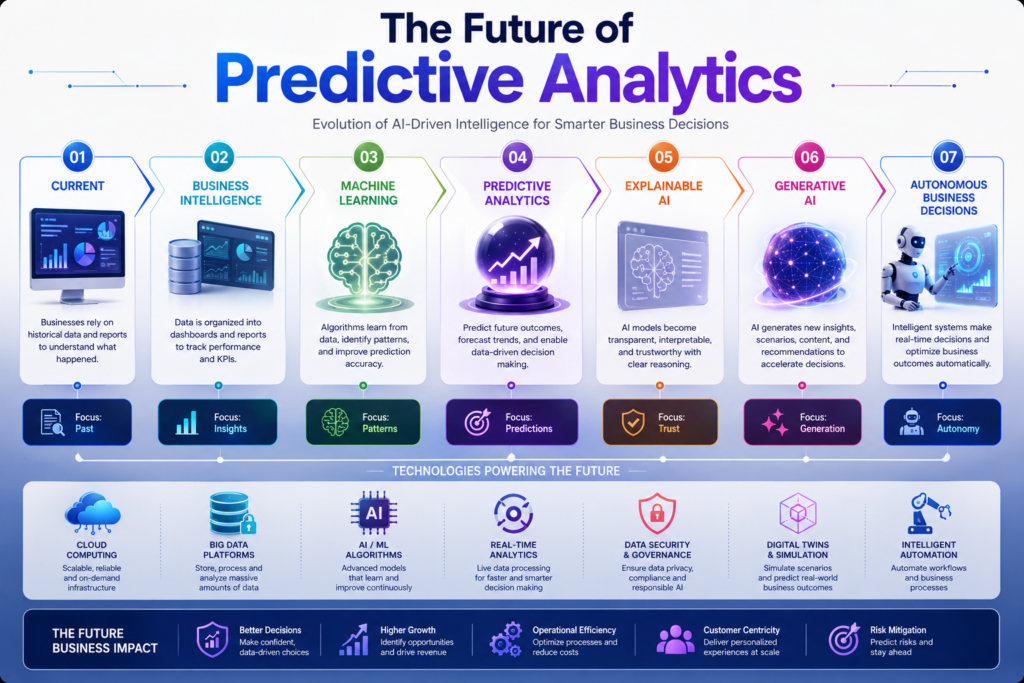
Key trends include:
Generative AI Integration
Predictive analytics is increasingly combined with generative AI to provide intelligent recommendations alongside forecasts.
Real-Time Analytics
Businesses are moving toward instant predictions using streaming data from websites, mobile applications, and IoT devices.
Explainable AI
Organizations increasingly require transparent AI models that explain why predictions are made.
Explainable AI improves trust and regulatory compliance.
Edge Computing
Processing data closer to devices enables faster decision-making with lower latency.
Automated Machine Learning (AutoML)
AutoML platforms reduce the technical complexity of building predictive models, allowing more organizations to adopt advanced analytics.
How Custom Software Enhances Predictive Analytics
Every organization has unique workflows, data sources, and business objectives. Generic software may not always provide the flexibility needed for advanced predictive analytics.
Custom-built applications can integrate predictive models directly into daily business processes, enabling features such as automated dashboards, real-time alerts, intelligent reporting, customer behavior analysis, and operational forecasting. Businesses planning to implement AI-driven analytics often benefit from tailored software solutions that align with their existing infrastructure and long-term digital strategy. More information about custom software, web, cloud, and application development services can be found at technobotsystem services, where businesses can explore technology solutions designed to support data-driven growth.
Conclusion
The ability to make faster, smarter, and more informed decisions has become a competitive advantage for organizations of every size. Predictive analytics helps businesses make better decisions by transforming historical data into meaningful forecasts that support strategic planning, improve customer experiences, optimize operations, and reduce business risks.
As artificial intelligence, machine learning, and cloud technologies continue to advance, predictive analytics will become even more accessible and impactful. Organizations that invest in quality data, modern technology infrastructure, and well-designed analytics solutions will be better positioned to anticipate change instead of merely reacting to it.
Whether the goal is improving sales forecasting, reducing operational costs, enhancing customer engagement, or driving innovation, predictive analytics provides the insights needed to make confident, data-driven decisions. Businesses that begin their analytics journey today will be better prepared to navigate tomorrow’s opportunities and challenges.