Modern software development moves faster than ever before. Businesses expect rapid feature delivery, stable releases, secure infrastructure, and seamless user experiences across web and mobile platforms. As a result, development teams must adopt smarter workflows that reduce manual work while improving software quality.
This is where Continuous Integration vs Continuous Deployment (CI/CD) becomes one of the most important concepts in modern DevOps practices.
CI/CD helps organizations automate software delivery, reduce deployment risks, and accelerate innovation. Whether companies are building enterprise applications, SaaS platforms, eCommerce systems, or cloud-native products, CI/CD pipelines allow development teams to release updates more efficiently and reliably.
Many modern development teams working on scalable digital products and custom software solutions now integrate DevOps practices into their workflows to improve delivery speed and maintain code quality. Businesses exploring advanced automation workflows often rely on professional DevOps and software engineering solutions available through Technobot System.
In this detailed guide, we will explore:
- What CI/CD means
- The difference between Continuous Integration and Continuous Deployment
- Why CI/CD matters in software development
- Popular CI/CD tools
- Best practices
- Common challenges
- Real-world use cases
- Future trends in DevOps automation
What is CI/CD?
CI/CD stands for:
- Continuous Integration (CI)
- Continuous Delivery (CD)
- Continuous Deployment (CD)
These practices automate the software development lifecycle, especially code integration, testing, building, and deployment.
The main objective of CI/CD is to:
- Reduce manual errors
- Increase release speed
- Improve software quality
- Enhance collaboration between developers and operations teams
- Deliver faster updates to users
CI/CD is one of the core pillars of modern DevOps methodologies.
According to the official AWS DevOps Guide, organizations implementing DevOps and CI/CD pipelines often achieve significantly faster release cycles and improved operational stability.
Understanding Continuous Integration vs Continuous Deployment helps businesses choose the right automation strategy for faster and more reliable software delivery.
Understanding Continuous Integration (CI)
What is Continuous Integration?
Continuous Integration is a development practice where developers frequently merge code changes into a shared repository.
Every time new code is committed:
- Automated builds run
- Unit tests execute
- Integration tests validate functionality
- Code quality checks occur automatically
The goal is to identify issues early before they become larger problems.
Instead of waiting weeks or months to integrate code, CI enables teams to integrate small changes continuously.
How Continuous Integration Works
A typical CI workflow includes:
- Developer writes code
- Code is pushed to Git repository
- CI server detects changes
- Automated build process starts
- Automated tests execute
- Results are shared with developers
- Errors are fixed immediately
Popular CI tools include:
- Jenkins
- GitHub Actions
- GitLab CI/CD
- CircleCI
- Travis CI
- Azure DevOps
Key Benefits of Continuous Integration
Faster Bug Detection
Continuous testing helps developers identify problems immediately after code changes.
As a result, teams fix bugs before they impact production systems.
Better Collaboration
Multiple developers can work on the same project without causing major integration conflicts.
CI creates a smoother collaborative workflow.
Improved Code Quality
Automated testing and static code analysis improve maintainability and reliability.
Faster Development Cycles
Because developers integrate changes frequently, software releases become faster and more predictable.
Reduced Manual Work
Automation minimizes repetitive tasks such as testing and build validation.
What is Continuous Delivery?
Continuous Delivery is the next step after Continuous Integration.
Once code passes automated testing, it becomes ready for deployment to production environments.
However, deployment still requires manual approval.
This approach ensures software can be released at any time with minimal risk.
Continuous Delivery Workflow
A Continuous Delivery pipeline generally includes:
- Automated testing
- Build validation
- Security checks
- Packaging
- Staging deployment
- Manual production approval
Continuous Delivery provides flexibility because businesses can choose when to release updates.
What is Continuous Deployment?
Continuous Deployment goes one step further.
In this model, every code change that passes automated tests is automatically deployed to production without manual approval.
This creates a fully automated release pipeline.
Companies like Netflix, Amazon, and Facebook use advanced Continuous Deployment systems to deliver updates rapidly.
Continuous Integration vs Continuous Deployment (CI/CD) Explained
Key Difference Between CI and Continuous Deployment
Although both concepts are connected, they solve different problems.
| Feature | Continuous Integration | Continuous Deployment |
|---|---|---|
| Purpose | Merge and test code frequently | Automatically release validated code |
| Main Focus | Code quality | Deployment automation |
| Automation Level | Build and test automation | Full production deployment automation |
| Human Approval | Usually required before deployment | Not required |
| Risk Reduction | Detects bugs early | Reduces deployment delays |
| Deployment Frequency | Frequent builds | Frequent releases |
In simple terms:
- Continuous Integration ensures code works correctly.
- Continuous Deployment ensures software reaches users quickly.
Together, they form a complete CI/CD pipeline.
Why CI/CD Matters in Modern Software Development
Modern applications require continuous updates.
Users expect:
- Faster feature releases
- Better performance
- Stable applications
- Strong security
- Quick bug fixes
Without automation, software delivery becomes slow and error-prone.
CI/CD solves these challenges efficiently.
Supports Agile Development
CI/CD aligns perfectly with Agile methodologies because it encourages small, incremental updates.
Improves Customer Experience
Faster releases allow businesses to respond quickly to customer feedback.
Reduces Downtime
Automated testing minimizes deployment failures.
Enables Scalability
CI/CD pipelines support large-scale cloud applications and microservices architectures.
Organizations developing scalable web applications, enterprise platforms, and cloud-native systems often combine CI/CD with automation-focused architectures. Many businesses also explore scalable backend strategies such as Event-Driven Architecture in Node.js to improve deployment efficiency and application performance.
Core Components of a CI/CD Pipeline
A CI/CD pipeline consists of multiple automated stages.
Source Control Management
Code is stored in repositories such as:
- GitHub
- GitLab
- Bitbucket
Build Automation
The system compiles code automatically after commits.
Automated Testing
Testing includes:
- Unit testing
- Integration testing
- UI testing
- Security testing
- Performance testing
Artifact Management
Build outputs are stored securely for deployment.
Deployment Automation
Applications are deployed to staging or production environments automatically.
Monitoring and Feedback
Monitoring tools track application health and performance after deployment.
Popular CI/CD Tools
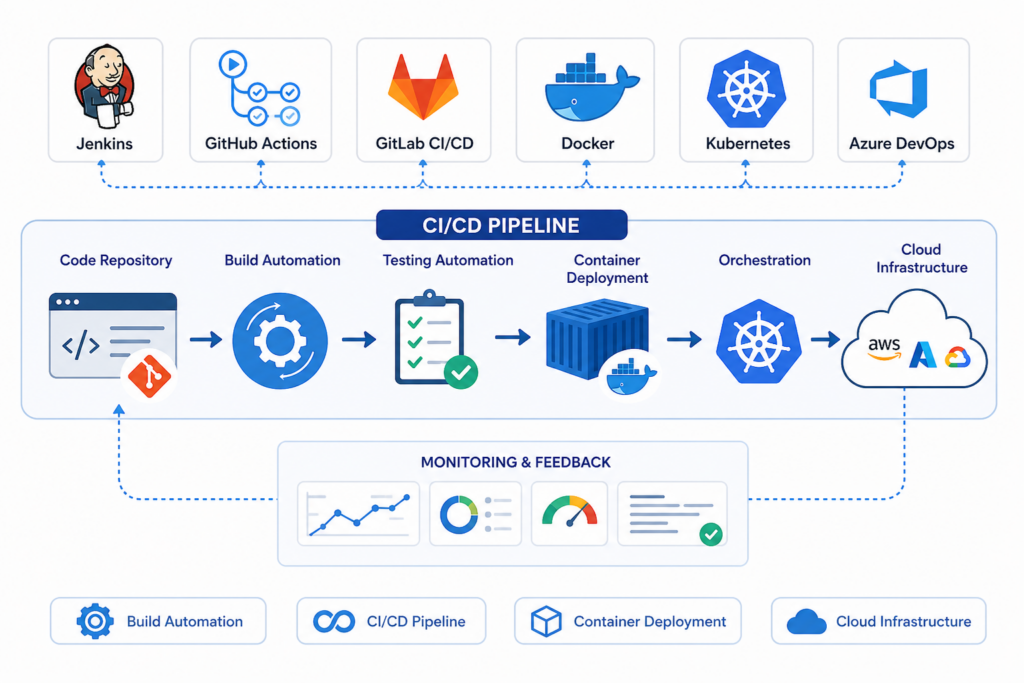
Choosing the right CI/CD tool depends on project size, infrastructure, and business goals.
Jenkins
Jenkins is one of the most widely used open-source automation servers.
Advantages
- Highly customizable
- Large plugin ecosystem
- Strong community support
Best For
- Enterprise environments
- Complex workflows
GitHub Actions
GitHub Actions integrates directly with GitHub repositories.
Advantages
- Easy setup
- Native GitHub integration
- Cloud-friendly workflows
Best For
- Modern cloud applications
- Open-source projects
GitLab CI/CD
GitLab provides built-in CI/CD capabilities within its DevOps platform.
Advantages
- Integrated DevOps lifecycle
- Strong security features
- Easy pipeline management
CircleCI
CircleCI focuses on speed and cloud-native automation.
Advantages
- Fast build execution
- Docker support
- Scalable pipelines
Azure DevOps
Microsoft Azure DevOps offers enterprise-grade CI/CD capabilities.
Advantages
- Strong Microsoft ecosystem integration
- Enterprise scalability
- Advanced reporting
The discussion around Continuous Integration vs Continuous Deployment is becoming increasingly important as organizations adopt cloud-native infrastructure and DevOps automation.
CI/CD Best Practices
Successful CI/CD implementation requires proper planning.
Commit Small Changes Frequently
Smaller commits reduce merge conflicts and simplify debugging.
Automate Testing
Testing should cover:
- Functional validation
- Security checks
- Performance testing
- Regression testing
Maintain Pipeline Security
Secure secrets, API keys, and deployment credentials properly.
The OWASP DevSecOps Guidelines provide valuable recommendations for integrating security into CI/CD workflows.
Monitor Deployments Continuously
Track system health after every deployment.
Use Infrastructure as Code (IaC)
Tools like Terraform and Kubernetes improve deployment consistency.
Keep Pipelines Fast
Slow pipelines reduce developer productivity.
Optimize test execution and build times regularly.
Common CI/CD Challenges
Although CI/CD offers major advantages, organizations may face implementation challenges.
Complex Pipeline Configuration
Large projects often require advanced automation logic.
Flaky Tests
Unstable automated tests can create unreliable pipelines.
Security Risks
Poorly secured pipelines may expose sensitive credentials.
Resistance to Change
Teams unfamiliar with DevOps practices may initially resist automation adoption.
Legacy Infrastructure
Older systems sometimes lack compatibility with modern CI/CD workflows.
However, experienced development teams can gradually modernize infrastructure and automate workflows using scalable DevOps strategies and cloud-based deployment architectures.
CI/CD in Cloud-Native Development
CI/CD plays a critical role in cloud-native environments.
Modern cloud applications rely on:
- Containers
- Kubernetes
- Microservices
- Serverless infrastructure
CI/CD enables rapid deployment across distributed environments.
CI/CD and Kubernetes
Kubernetes automates container orchestration.
Combined with CI/CD, it enables:
- Rolling deployments
- Auto-scaling
- Zero-downtime releases
- Self-healing infrastructure
CI/CD and Serverless
Serverless applications benefit from rapid deployment automation.
This allows developers to release cloud functions quickly and efficiently.
Real-World Example of CI/CD Workflow
Imagine a team developing an eCommerce application.
Step 1: Developer Commits Code
A developer adds a new payment feature.
Step 2: CI Pipeline Starts
The system automatically:
- Builds the application
- Runs unit tests
- Validates dependencies
Step 3: Security Scanning
Automated tools scan for vulnerabilities.
Step 4: Staging Deployment
The application deploys to a staging environment.
Step 5: Automated UI Testing
The system validates checkout flows and user interactions.
Step 6: Production Deployment
If all tests pass, deployment occurs automatically.
This entire process may take only a few minutes.
The Future of CI/CD
CI/CD continues evolving rapidly alongside cloud computing and AI technologies.
AI-Powered Testing
Artificial intelligence can improve automated test generation and bug detection.
DevSecOps Integration
Security is becoming fully integrated into CI/CD pipelines.
GitOps Adoption
GitOps enables infrastructure management through Git repositories.
Greater Automation
Organizations are moving toward fully autonomous deployment pipelines.
Improved Observability
Advanced monitoring tools provide deeper insights into deployments and application health.
Businesses investing in digital transformation increasingly prioritize automated delivery pipelines because they improve operational efficiency, scalability, and product reliability. Companies seeking long-term technology growth often adopt advanced DevOps practices alongside modern software engineering services available through experienced IT solution providers such as Technobot System’s development solutions.
When Should Businesses Implement CI/CD?
CI/CD becomes especially valuable when organizations:
- Release software frequently
- Manage multiple developers
- Build cloud-native applications
- Require faster deployment cycles
- Need higher software reliability
- Operate Agile development teams
Even small startups can benefit from CI/CD automation because it reduces operational overhead and improves development consistency.
How CI/CD Improves Business Outcomes
CI/CD is not only a technical improvement.
It also creates measurable business value.
Faster Time-to-Market
Businesses launch features more quickly.
Reduced Operational Costs
Automation lowers manual deployment effort.
Better Product Stability
Frequent testing improves reliability.
Improved Team Productivity
Developers spend less time fixing integration issues.
Higher Customer Satisfaction
Users receive faster updates and fewer bugs.
Conclusion
Understanding Continuous Integration vs Continuous Deployment is essential for modern software teams and businesses investing in digital transformation.
Continuous Integration helps teams detect issues early by automating code integration and testing. Meanwhile, Continuous Deployment automates software releases, enabling faster and more reliable delivery to users.
Together, CI/CD pipelines improve:
- Software quality
- Deployment speed
- Team collaboration
- Security
- Scalability
- Customer experience
As cloud computing, DevOps, and automation technologies continue evolving, CI/CD will remain one of the most important foundations of efficient software development.
Organizations adopting modern CI/CD workflows can deliver software faster, reduce operational risks, and remain competitive in an increasingly technology-driven marketplace. Businesses looking to modernize their development infrastructure often partner with experienced teams offering advanced custom software development services.