
RPA in Streamlining Workflows has become one of the most important strategies for organizations seeking greater efficiency, reduced operational costs, and improved business productivity. In today’s fast-paced digital economy, businesses are under constant pressure to optimize processes while maintaining high levels of accuracy and customer satisfaction. As organizations continue to embrace digital transformation, one technology has emerged as a powerful catalyst for productivity and process optimization: Robotic Process Automation (RPA).
RPA enables businesses to automate repetitive, rule-based tasks that traditionally require human intervention. From data entry and invoice processing to customer support workflows and compliance reporting, RPA helps organizations eliminate manual bottlenecks and improve operational accuracy.
Companies investing in digital transformation often combine automation with modern software solutions such as custom web application development to create highly efficient business ecosystems.
In this article, we will explore the role of RPA in streamlining workflows, its benefits, implementation strategies, challenges, and future trends that are shaping modern enterprises.
Understanding Robotic Process Automation (RPA)
Robotic Process Automation (RPA) is a software technology that uses bots or digital workers to automate repetitive and structured tasks across applications and systems.
Unlike traditional automation solutions that require deep system integrations, RPA bots interact with software applications similarly to human users. They can:
- Log into applications
- Copy and paste data
- Fill out forms
- Process transactions
- Generate reports
- Extract information from documents
- Communicate between multiple systems
These bots work continuously without fatigue, helping businesses improve productivity while reducing human errors.
How RPA Works
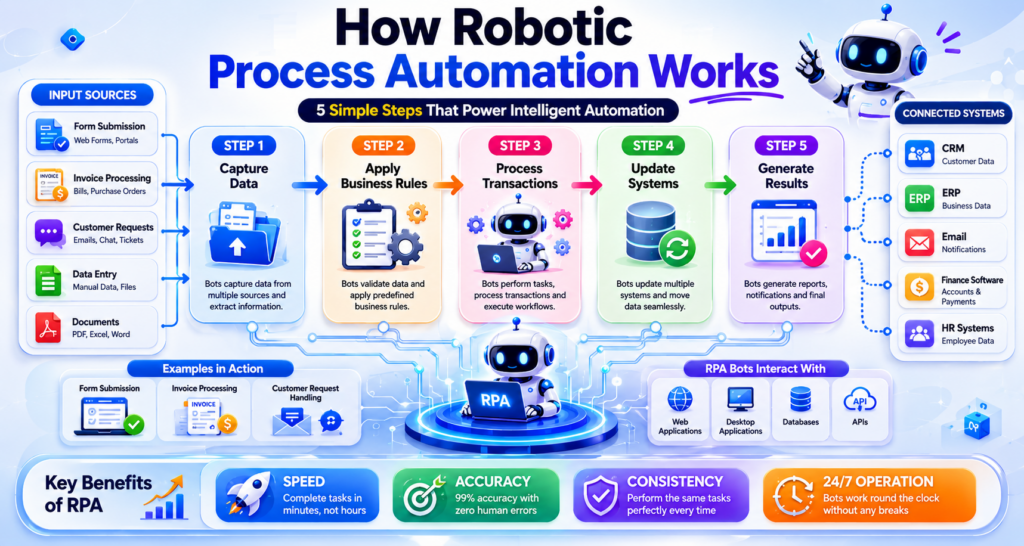
RPA bots follow predefined rules and workflows.
The process generally includes:
- Capturing data from applications.
- Applying business rules.
- Performing required actions.
- Recording outcomes.
- Triggering subsequent workflow steps.
For example, when a customer submits an online form, an RPA bot can automatically validate the information, update internal systems, send confirmation emails, and notify relevant departments without human involvement.
Why Businesses Need Workflow Automation
Modern organizations often operate across multiple software platforms, departments, and processes.
Manual workflows create several challenges:
- Delayed processing times
- Human errors
- High operational costs
- Compliance risks
- Employee burnout
- Inefficient resource allocation
Consequently, businesses are increasingly turning to RPA in streamlining workflows to create faster, more reliable operations.
According to research from Gartner, automation technologies continue to play a critical role in enterprise digital transformation initiatives worldwide.
The Role of RPA in Streamlining Workflows
Eliminating Repetitive Manual Tasks
One of the primary benefits of RPA is its ability to automate repetitive activities.
Examples include:
- Data migration
- Form processing
- Invoice generation
- Payroll updates
- Order management
- Customer onboarding
Instead of spending hours on repetitive administrative tasks, employees can focus on higher-value work such as decision-making, innovation, and customer engagement.
This significantly improves workforce productivity while reducing operational inefficiencies.
Improving Process Accuracy
Human errors are inevitable when performing repetitive tasks repeatedly.
Common mistakes include:
- Typographical errors
- Missing information
- Duplicate records
- Incorrect calculations
RPA bots execute tasks exactly according to predefined rules.
As a result:
- Data consistency improves.
- Compliance risks decrease.
- Reporting accuracy increases.
- Customer experiences improve.
For industries such as healthcare, finance, insurance, and legal services, accuracy is particularly critical.
Accelerating Business Operations
Speed is a competitive advantage in modern business.
RPA bots can operate:
- 24/7
- Without breaks
- Across multiple systems simultaneously
Tasks that may take employees several hours can often be completed in minutes.
Examples include:
Customer Service Requests
Bots can:
- Retrieve customer information
- Verify account details
- Update records
- Trigger service requests
This leads to faster customer response times.
Financial Transactions
RPA can automate:
- Invoice processing
- Payment verification
- Expense management
- Reconciliation tasks
Organizations benefit from quicker financial operations and improved cash flow management.
Enhancing Employee Productivity
A common misconception is that RPA replaces employees.
In reality, successful automation initiatives empower employees by removing repetitive tasks from their daily workload.
Employees gain more time to focus on:
- Strategic planning
- Customer relationships
- Problem-solving
- Innovation
- Business development
This creates a more engaged and productive workforce.
Strengthening Compliance and Audit Readiness
Many industries operate under strict regulatory requirements.
RPA helps organizations maintain compliance by:
- Following standardized procedures
- Recording every action performed
- Maintaining audit trails
- Reducing compliance violations
For example, financial institutions can automate Know Your Customer (KYC) processes while ensuring every step is documented for regulatory audits.
Key Industries Benefiting from RPA
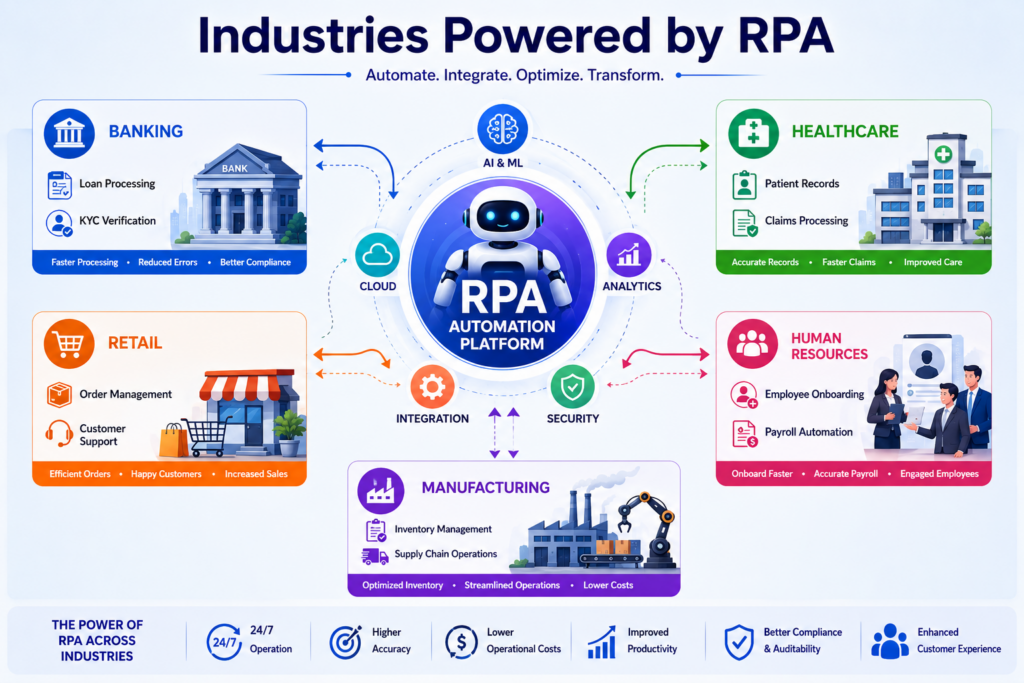
Banking and Financial Services
Banks use RPA to automate:
- Loan processing
- Account opening
- Fraud detection support
- Compliance reporting
- Customer verification
These automated workflows reduce processing times while improving customer satisfaction.
Healthcare
Healthcare organizations use RPA for:
- Patient registration
- Claims processing
- Appointment scheduling
- Medical record management
- Billing operations
Automation reduces administrative burdens and allows healthcare professionals to focus more on patient care.
Human Resources
HR departments benefit from automated:
- Employee onboarding
- Payroll processing
- Leave management
- Performance tracking
- Recruitment workflows
Organizations integrating HR automation with custom enterprise software often achieve even greater operational efficiency.
Manufacturing
Manufacturers leverage RPA to automate:
- Inventory management
- Procurement workflows
- Supply chain reporting
- Quality assurance documentation
- Production scheduling support
This helps improve operational visibility and productivity.
Retail and E-Commerce
Retail businesses use RPA to automate:
- Order processing
- Customer support requests
- Inventory updates
- Product catalog management
- Returns handling
The result is faster customer service and improved operational efficiency.
RPA and Digital Transformation
RPA is often considered a foundational component of digital transformation.
However, automation alone is not enough.
Organizations achieve the best results when RPA is combined with:
- Artificial Intelligence (AI)
- Machine Learning (ML)
- Cloud Computing
- Data Analytics
- Custom Software Solutions
For example, businesses implementing automation alongside custom software development services can build intelligent systems.
Similarly, companies exploring modern automation strategies may find valuable insights in related resources such as AI in Software Development, where AI-driven technologies further enhance workflow automation capabilities.
Major Benefits of RPA Implementation
Cost Reduction
Automation reduces labor-intensive processes and minimizes operational expenses.
Businesses often achieve:
- Lower processing costs
- Reduced rework
- Fewer compliance penalties
- Improved resource utilization
Scalability
As businesses grow, manual processes become increasingly difficult to manage.
RPA allows organizations to scale operations quickly without proportionally increasing staffing requirements.
Bots can handle increased workloads efficiently and consistently.
Improved Customer Experience
Customers expect:
- Faster responses
- Accurate information
- Seamless interactions
RPA helps meet these expectations by automating customer-facing processes and reducing delays.
Better Data Management
Data is one of the most valuable assets in modern organizations.
RPA improves data quality by:
- Standardizing inputs
- Reducing duplicate records
- Automating validation
- Enhancing reporting accuracy
Increased Business Agility
Organizations can adapt more quickly to market changes when workflows are automated.
This flexibility enables faster decision-making and operational responsiveness.
Challenges of Implementing RPA
While RPA offers significant advantages, organizations should also understand potential challenges.
Process Selection Issues
Not every process is suitable for automation.
Ideal RPA candidates are:
- Repetitive
- Rule-based
- High-volume
- Stable
Poor process selection can limit automation benefits.
Change Management
Employees may initially resist automation initiatives.
Organizations should:
- Communicate clearly
- Provide training
- Involve stakeholders early
- Demonstrate benefits
Strong change management improves adoption success.
Maintenance Requirements
Business processes evolve over time.
Consequently, RPA bots require ongoing monitoring and updates to remain effective.
Regular maintenance ensures optimal performance.
Security Considerations
Automated systems often handle sensitive business information.
Organizations should implement:
- Access controls
- Encryption
- Monitoring systems
- Security policies
The National Institute of Standards and Technology (NIST) provides valuable cybersecurity guidance through its official resources at nist gov.
Best Practices for Successful RPA Adoption
Start Small and Scale Gradually
Begin with a pilot project involving a single process.
Evaluate:
- Performance improvements
- Cost savings
- User feedback
- Operational impact
Successful pilots can then be expanded across departments.
Focus on Process Optimization First
Automating an inefficient process simply accelerates inefficiency.
Before automation:
- Analyze workflows
- Remove unnecessary steps
- Standardize procedures
- Document business rules
This maximizes automation effectiveness.
Establish Governance Frameworks
Organizations should create governance structures that define:
- Roles and responsibilities
- Security standards
- Performance metrics
- Compliance requirements
Proper governance reduces implementation risks.
Measure Performance Continuously
Track key performance indicators (KPIs) such as:
- Processing time
- Error rates
- Cost savings
- Productivity improvements
- Customer satisfaction
Continuous measurement supports long-term success.
The Future of RPA
The future of automation extends beyond simple task execution.
Emerging technologies are transforming RPA into intelligent automation platforms.
Future trends include:
AI-Powered Automation
AI enables bots to:
- Understand natural language
- Process unstructured data
- Make predictive decisions
- Learn from patterns
Hyperautomation
Hyperautomation combines:
- RPA
- Artificial Intelligence
- Machine Learning
- Process Mining
- Analytics
This creates end-to-end automated business ecosystems.
Cloud-Based Automation
Cloud technologies are making automation more accessible and scalable.
Organizations can deploy automation solutions faster while reducing infrastructure costs.
Intelligent Document Processing
Advanced automation tools can now process:
- Contracts
- Invoices
- Forms
- Emails
- PDFs
using AI-driven document understanding capabilities.
Conclusion
The role of RPA in streamlining workflows has become increasingly important as organizations pursue operational excellence and digital transformation. By automating repetitive tasks, improving accuracy, accelerating business processes, and enhancing employee productivity, RPA delivers measurable business value across industries.
From banking and healthcare to manufacturing and retail, organizations are leveraging automation to improve efficiency and remain competitive in rapidly evolving markets. When combined with technologies such as AI, cloud computing, and custom software solutions, RPA becomes a powerful driver of innovation and business growth.
Businesses seeking long-term success should view automation not merely as a cost-saving initiative but as a strategic investment in agility, scalability, and customer satisfaction. Furthermore, Organizations looking to modernize operations through intelligent software solutions can explore insights available on the Technobot System Blog to stay updated with automation and digital transformation trends.
As automation technologies continue to evolve, the role of RPA in streamlining workflows will only become more significant, helping organizations build smarter, faster, and more resilient business operations.