Native vs Hybrid Apps: Which One Should Businesses Choose?
In today’s digital-first world, mobile applications are no longer optional — they are a core business asset. Whether you’re a startup launching your first product or an enterprise scaling operations, one critical decision defines your app’s success:
Should you build a Native app or a Hybrid app?
Although both options seem similar on the surface, the long-term business impact differs massively. Therefore, understanding the technical, financial, and strategic differences is essential before investing.
🚀 What Is a Native App?
A Native app is built specifically for a single platform using its official technologies:
| Platform | Language |
|---|---|
| Android | Kotlin / Java |
| iOS | Swift / Objective-C |
These apps interact directly with device hardware, resulting in unmatched speed and responsiveness.
Key Characteristics:
- High performance
- Full access to device features
- Best UI/UX experience
- Higher development cost
Real-World Examples:
- Spotify
🔄 What Is a Hybrid App?
A Hybrid app uses a single codebase to run across multiple platforms. Popular frameworks include:
- Flutter
- React Native
- Ionic
Key Characteristics:
- Faster development
- Lower cost
- Easier maintenance
- Slight performance compromise
Real-World Examples:
- Airbnb
- Alibaba
- Discord
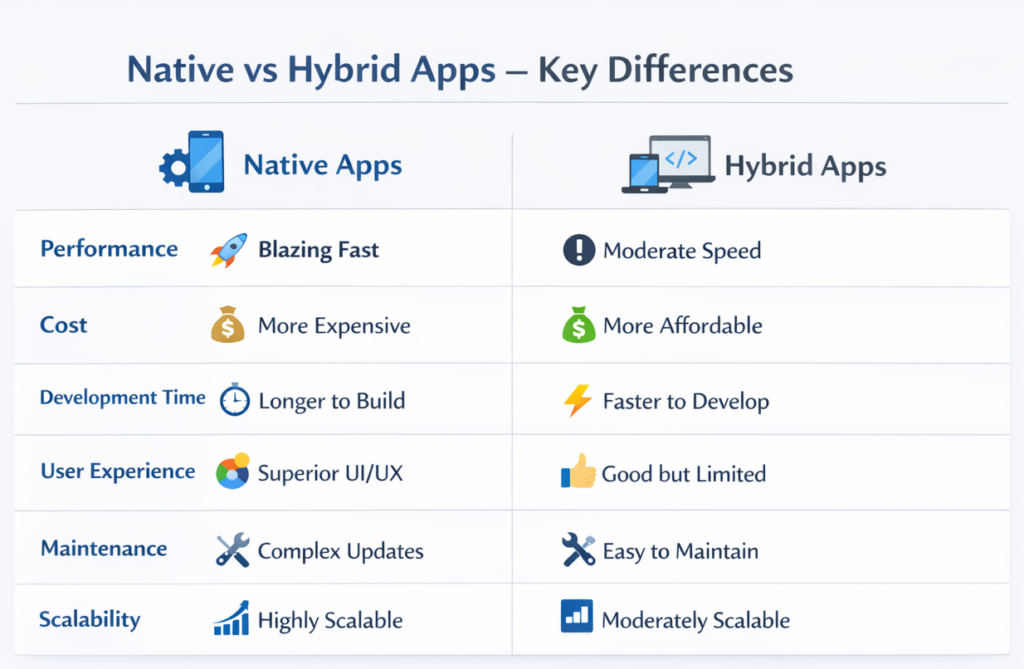
Native vs Hybrid Apps: Side-by-Side Comparison
| Factor | Native Apps | Hybrid Apps |
|---|---|---|
| Performance | ⚡ Extremely high | ⚠️ Moderate |
| Development Time | Slow | Fast |
| Cost | High | Low |
| UX/UI | Best possible | Good |
| Maintenance | Complex | Easy |
| Offline Support | Strong | Limited |
| Scalability | Excellent | Medium |
Which Is Better for Your Business?
Choose Native Apps if:
- You need complex animations
- You rely on GPS, camera, Bluetooth
- You want top-tier performance
- You have a long-term product roadmap
Choose Hybrid Apps if:
- You want MVP quickly
- You have limited budget
- You want cross-platform reach
- You plan frequent updates
🔹 Quote:
“Native apps win on performance. Hybrid apps win on speed to market.”
Cost Comparison (Realistic Estimates)
| App Type | Cost (India) |
|---|---|
| Native | ₹3,00,000 – ₹10,00,000 |
| Hybrid | ₹1,50,000 – ₹4,00,000 |
Performance & SEO Impact
Although mobile apps themselves are not indexed by Google, app performance impacts:
- App Store rankings
- User retention
- Brand trust
- Conversion rate
Poor performance leads to:
- High uninstall rate
- Negative reviews
- Lower engagement
Rare but Crucial Factors
1️⃣ App Store Approval Speed
Native apps pass review faster than hybrid apps.
2️⃣ Security Layer
Native apps allow:
- Biometric authentication
- Hardware encryption
- Secure APIs
Hybrid apps depend on browser security models.
3️⃣ Long-Term Maintenance Cost
Hybrid is cheaper initially. Native is cheaper long-term for scaling.
Real Business Use Case
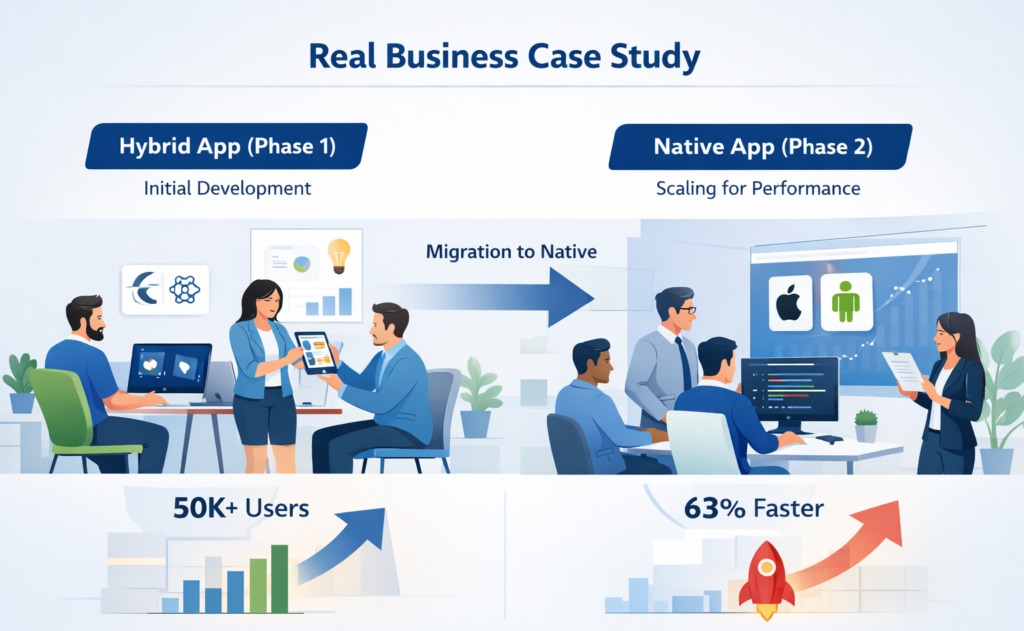
A logistics company builds a Hybrid MVP in Flutter for ₹2L.
After scaling to 50,000 users, performance drops.
They migrate to Native Android & iOS, increasing speed by 63%.
According to Google’s UX research, users abandon apps that load slower than 3 seconds.
Decision Framework (Business Matrix)
| Business Type | Recommendation |
|---|---|
| Startup | Hybrid |
| E-commerce | Native |
| SaaS MVP | Hybrid |
| Banking | Native |
| IoT App | Native |
| Social App | Hybrid → Native |
Final Verdict
There is no universal winner.
However:
- Hybrid apps dominate speed & cost
- Native apps dominate performance & security
Your decision must align with:
Growth strategy
Budget
Timeline
User base