
A business idea can start with something as simple as a customer complaint, an inefficient process, or a new way to solve a familiar problem. However, having a good idea is only the beginning. The real challenge is turning that idea into a digital product that people can understand, use, and continue using.
If you want to turn a business idea into a digital product, you need more than software development. You need to validate the problem, understand your target users, define the product scope, choose the right technology, design a practical user experience, build an MVP, test it with real users, and improve it based on evidence.
For businesses exploring custom digital solutions, custom web and mobile development services can help transform a business concept into a functional digital experience. The important point, however, is that development should come after the business problem and product requirements are clearly understood.
This guide explains the complete journey from an initial business idea to a working digital product.
What Does It Mean to Turn a Business Idea Into a Digital Product?
A digital product is a technology-based solution that delivers value to users. It can take many forms, including:
- A web application
- A mobile application
- A SaaS platform
- An online marketplace
- A customer portal
- An internal business management system
- An appointment or booking platform
- A subscription-based service
- An e-commerce platform
- A workflow or automation system
- A data or analytics platform
The key difference between an idea and a digital product is usability.
An idea explains what you want to create. A product explains what problem it solves, who it solves it for, how users interact with it, and how the business operates around it.
For example, imagine a business owner notices that small clinics struggle to manage appointments through phone calls and messaging apps.
The initial idea might be:
“I want to build an appointment booking app for clinics.”
That is a starting point, not yet a product definition.
A stronger product concept would identify the users, their problems, the essential workflow, the required features, the business model, and the expected outcome.
Start With the Problem, Not the Technology
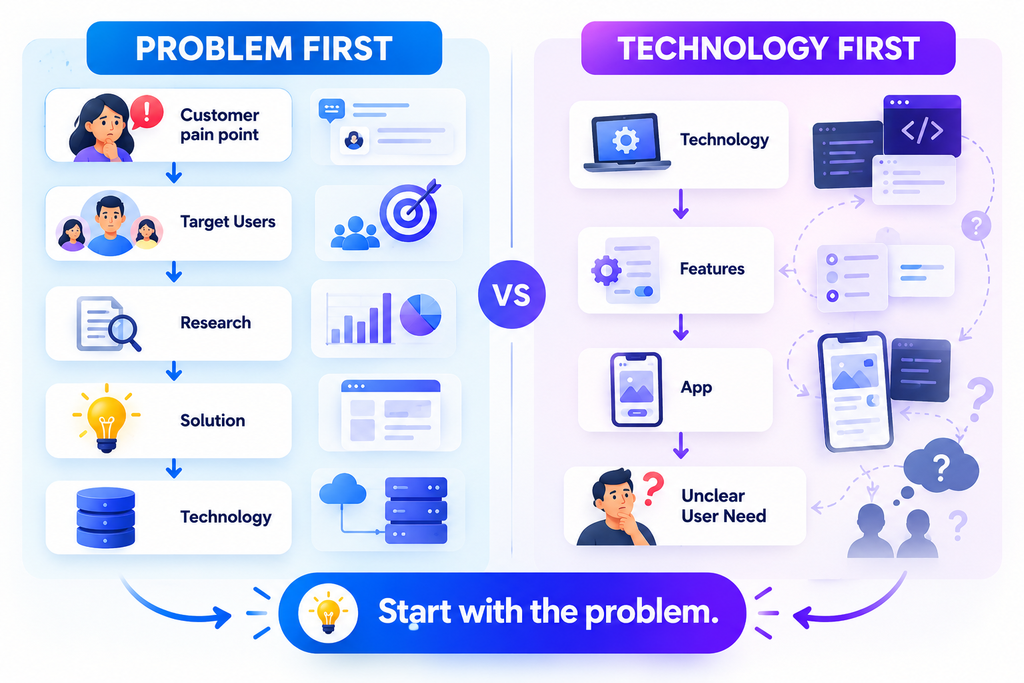
One of the most common mistakes when developing a new digital product is choosing technology before understanding the problem.
Businesses sometimes begin with questions such as:
- Should we use React?
- Should we build an Android and iOS app?
- Which database should we choose?
- Should we use cloud hosting?
- Should we add AI?
These questions may eventually matter, but they should not be the first questions.
Start with the customer.
Identify the Problem
Ask:
- What problem are users experiencing?
- Who experiences the problem?
- How frequently does it happen?
- How are people solving it today?
- What makes the existing solution difficult or expensive?
- What would improve the user’s experience?
A useful problem statement could look like this:
Small healthcare clinics lose appointment requests because customers have to call during working hours, creating unnecessary work for staff and making scheduling inconvenient for patients.
This is much more useful than simply saying, “We need a booking application.”
Define the Target User
A product should have a clear primary audience.
Your target user might be:
- Small business owners
- Sales teams
- Freelancers
- Students
- Healthcare professionals
- Retail customers
- Marketing teams
- Enterprise employees
Creating user personas can help you understand their goals, frustrations, technical comfort, and purchasing behavior.
The goal is not to create complicated documentation. It is to develop enough understanding to make better product decisions.
Validate the Business Idea Before Building
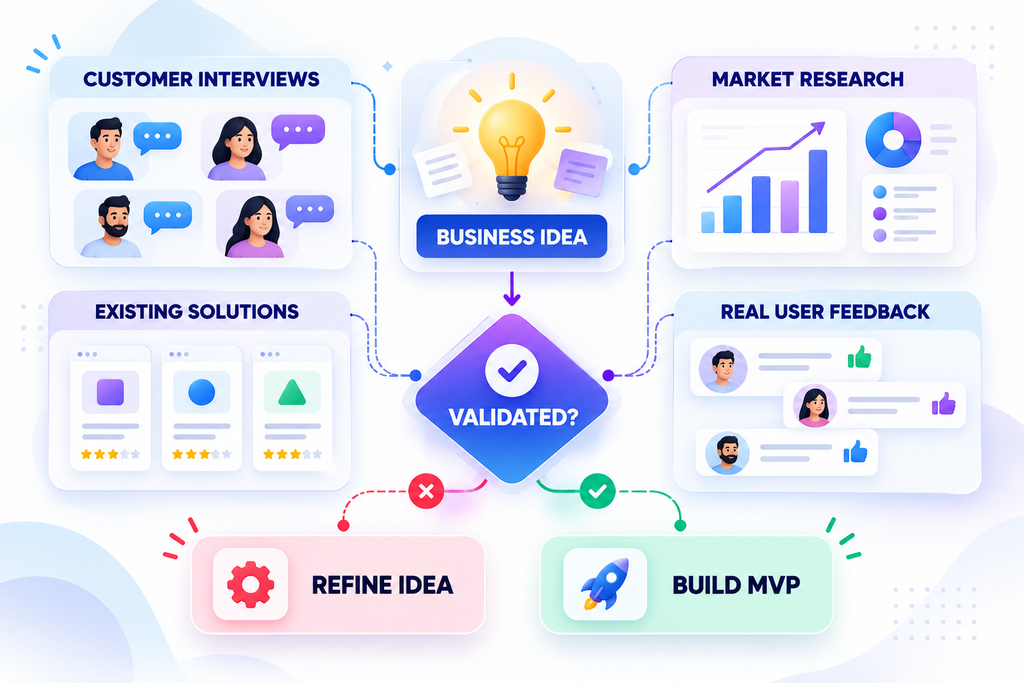
Once the problem is clear, validate whether the problem is significant enough to justify building a product.
Validation reduces the risk of spending months developing something that customers do not actually need.
Talk to Potential Users
Speak with people who represent your target audience.
Ask open-ended questions such as:
- How do you currently solve this problem?
- What is difficult about the current process?
- How often does this problem occur?
- What does it cost you in time or money?
- Have you tried another solution?
- What would an ideal solution look like?
Avoid asking only questions that encourage people to agree with your idea.
Instead of asking:
“Would you use my new app?”
ask:
“How do you currently handle this task?”
Actual behavior usually provides more useful information than hypothetical interest.
Research Existing Solutions
Competition is not necessarily a reason to abandon an idea. It can reveal what users already expect and where existing products leave gaps.
Study:
- Competitor features
- Pricing
- User reviews
- Customer complaints
- Onboarding processes
- Product limitations
- Support experience
- Platform availability
Look for opportunities to solve a specific problem better rather than trying to copy every feature available in the market.
Define the Product Requirements
After validation, convert the business idea into clear product requirements.
This is where an idea starts becoming a product specification.
Create a simple document covering:
Business Goals
Define what the business wants to achieve.
Examples include:
- Generate subscription revenue
- Reduce operational workload
- Improve customer retention
- Increase online sales
- Create a new revenue channel
- Replace a manual workflow
User Goals
Then define what users should be able to accomplish.
For example:
- Create an account
- Search for available services
- Make a booking
- Receive confirmation
- Manage appointments
- Make payments
- View previous transactions
Functional Requirements
Functional requirements describe what the system must do.
For example:
Users can create an account using email and password.
Customers can select an available appointment slot.
Administrators can manage schedules from a dashboard.
Non-Functional Requirements
These describe how the product should perform.
They can include:
- Security
- Performance
- Scalability
- Availability
- Accessibility
- Data privacy
- Reliability
- Maintainability
This distinction helps development teams understand both the features and the expected quality of the system.
Turn a Business Idea Into a Digital Product With an MVP
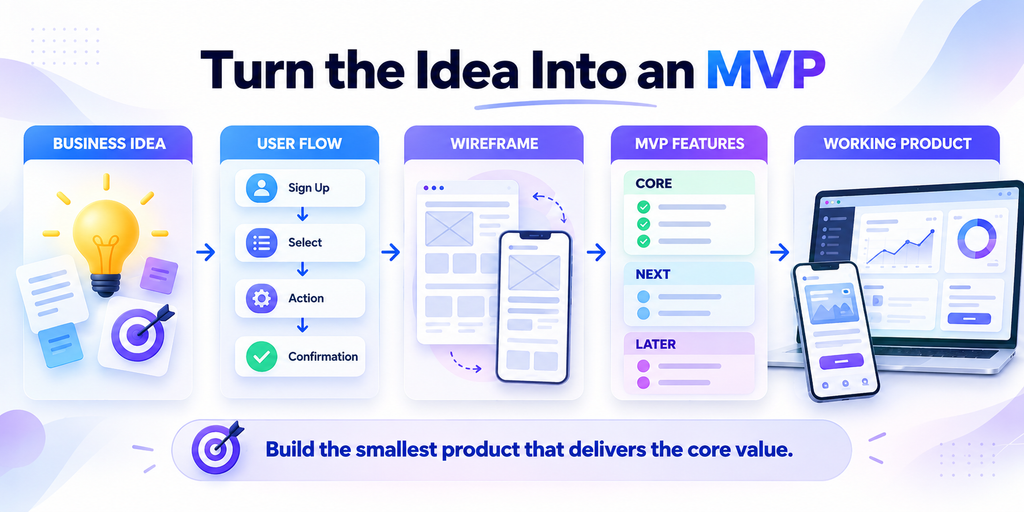
One of the most important steps when you turn a business idea into a digital product is defining the Minimum Viable Product, or MVP.
An MVP is not simply a smaller version of the final product. It is the smallest practical version that can deliver the core value and generate meaningful feedback.
For example, an appointment platform might eventually include:
- Online booking
- Mobile apps
- Video consultations
- Automated reminders
- Payments
- Loyalty programs
- Analytics
- Multiple staff accounts
- AI recommendations
Building everything at once can increase cost, complexity, and development time.
Instead, the first version might contain:
- User registration
- Service selection
- Appointment booking
- Basic payment functionality
- Booking management
- Administrator dashboard
Once users interact with that version, the business can learn which features actually matter.
This approach aligns with the broader product-development principle of testing assumptions early and improving the product through feedback. For additional perspective on product strategy and development planning, businesses can also explore relevant technology and product development resources.
Design the User Experience Before Development
A functional application can still fail if users find it confusing.
UX design should therefore happen before substantial development begins.
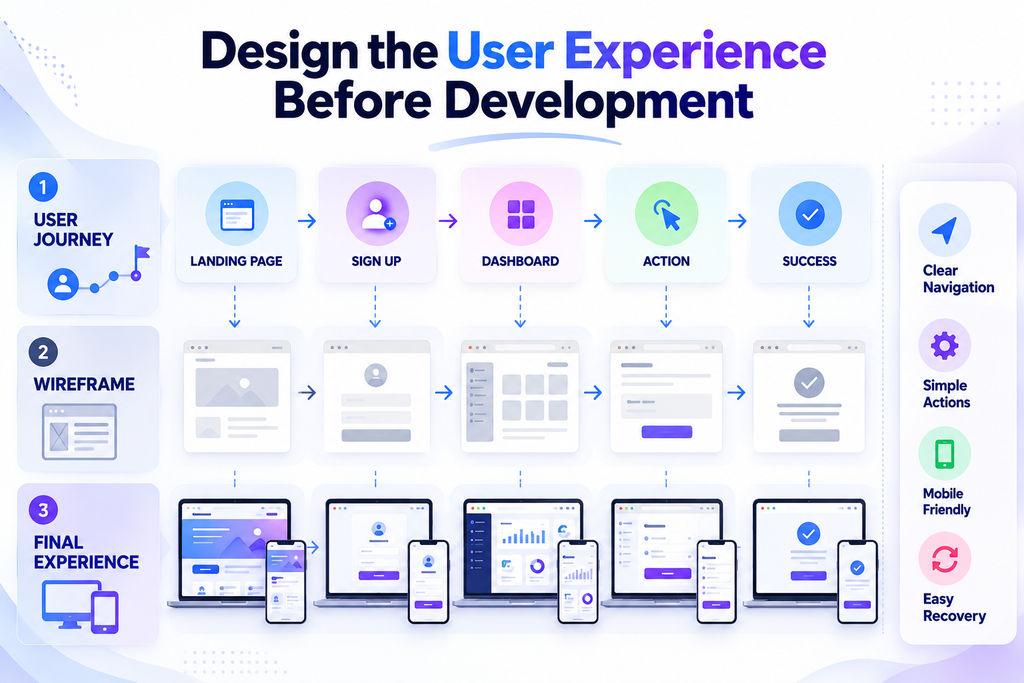
Map the User Journey
Consider the complete path a user takes.
For an online booking product:
Landing page → Sign up → Select service → Select date → Select time → Payment → Confirmation
Each step should have a clear purpose.
Ask:
- Is the next action obvious?
- Are there unnecessary steps?
- Can users recover from errors?
- Is important information easy to find?
- Does the interface work well on mobile devices?
Create Wireframes and Prototypes
Wireframes help establish structure before visual design.
A prototype can then demonstrate how screens connect and how users interact with the product.
This makes it easier to identify problems before developers spend time implementing them.
For complex products, prototype testing can also help stakeholders agree on requirements before development begins.
Choose the Right Technology Stack
Technology decisions should support the product rather than dictate it.
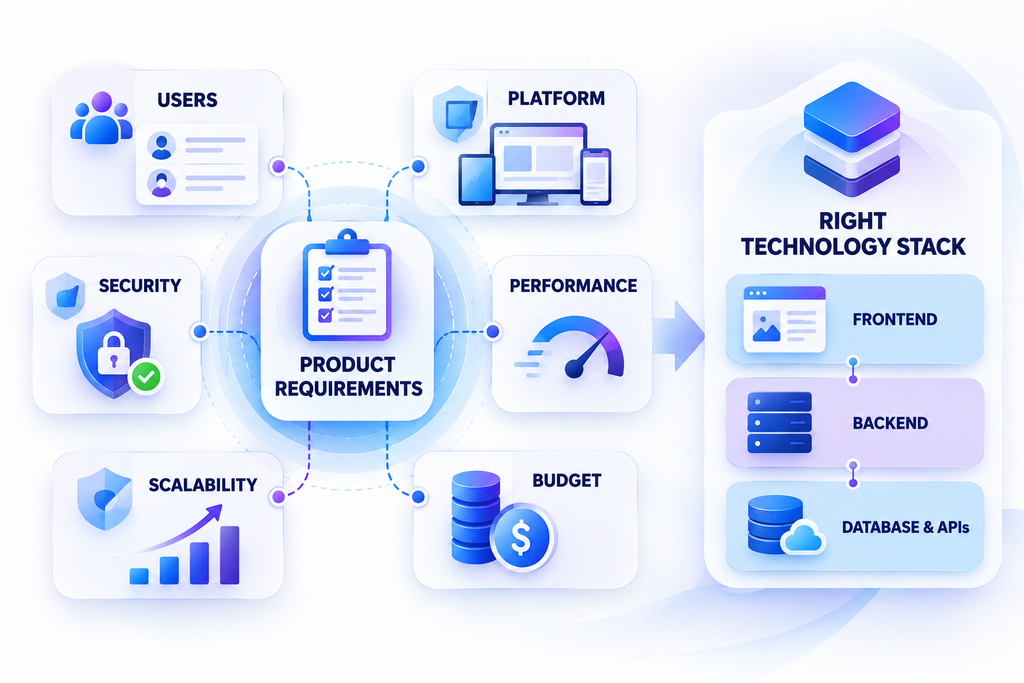
The right stack depends on factors such as:
- Product complexity
- Target platforms
- Expected traffic
- Development budget
- Security requirements
- Integration requirements
- Future scalability
- Available development expertise
For example, a simple customer portal may require a very different architecture from a real-time collaboration platform.
Web, Mobile, or Both?
Consider where your users naturally interact with the product.
A responsive web application may be appropriate when users primarily work through browsers.
A mobile application can make more sense when the product depends on:
- Frequent mobile usage
- Push notifications
- Camera access
- GPS
- Device-specific capabilities
- Offline functionality
In some cases, businesses may eventually need both web and mobile experiences.
The important point is to choose based on user behavior and business requirements rather than technology trends.
Build the Product in Development Stages
Once requirements, design, and technology decisions are established, development can begin.
A typical process may include:
1. Backend Development
The backend manages business logic, databases, authentication, APIs, and other server-side functions.
2. Frontend Development
The frontend provides the interface users interact with.
It should translate the approved UX design into a responsive and accessible experience.
3. API and Integration Development
Many digital products need connections with external systems such as:
- Payment gateways
- Email services
- CRM platforms
- Maps
- Analytics tools
- Authentication providers
- Cloud services
These integrations should be planned early because they can affect architecture and development timelines.
4. Database Development
The data model should reflect the product’s actual business requirements.
Poor database planning can create problems later when the product grows.
5. Security Implementation
Security should not be treated as a final-stage activity.
Authentication, authorization, secure data handling, input validation, encryption, access control, and monitoring should be considered throughout development.
For application security guidance, the OWASP Foundation provides widely used security resources and the OWASP Top 10 project covers common web application security risks.
Security considerations become particularly important when the product handles payments, personal information, business data, or authentication credentials.
Test the Product Before Launch
Testing should happen throughout development rather than only immediately before launch.
A structured testing process can include:
- Functional testing
- UI testing
- Usability testing
- Compatibility testing
- Performance testing
- Security testing
- API testing
- Mobile responsiveness testing
- User acceptance testing
Test Real User Flows
Do not test only individual buttons or screens.
Test complete journeys.
For example:
New user → Account creation → Login → Product selection → Checkout → Payment → Confirmation email
A product may appear functional when individual components are tested but still fail when the entire workflow is connected.
Test With Real Users
Before a public launch, allow a small group of representative users to try the product.
Observe:
- Where they hesitate
- What they misunderstand
- Which features they ignore
- Where they encounter errors
- What they expect to happen next
Their behavior can reveal usability problems that internal teams may overlook.
Launch With a Controlled Release
Launching a digital product does not mean everything needs to be completed on day one.
A controlled launch can reduce risk.
Depending on the product, you might use:
- Private beta testing
- Limited geographic launch
- Invite-only access
- Pilot customers
- Small business segments
- Feature flags
- Staged rollout
This gives the team an opportunity to monitor the product before exposing it to a larger audience.
Before launch, also prepare:
- Domain and hosting
- Analytics
- Error monitoring
- Backup strategy
- Security controls
- Customer support
- Privacy documentation
- Terms and conditions
- Deployment process
Measure What Happens After Launch
The first release provides something that planning cannot: real-world product data.
Track metrics that relate directly to your business goals.
Depending on the product, useful metrics may include:
- Sign-up conversion rate
- Activation rate
- Daily or monthly active users
- Retention rate
- Conversion rate
- Average order value
- Customer acquisition cost
- Churn
- Feature adoption
- Support requests
Do not measure everything simply because analytics tools make it possible.
Choose metrics that help answer important business questions.
For example:
Are users completing the onboarding process?
Are customers returning after their first transaction?
Which feature is used most frequently?
Where are users leaving the conversion funnel?
These insights can guide the next development cycle.
Improve the Product Through Continuous Iteration
A digital product should not be treated as a one-time project.
After launch, the product enters a continuous improvement cycle:
Measure → Learn → Prioritize → Develop → Test → Release → Measure Again
Customer feedback, analytics, technical performance, and business results should all influence the roadmap.
Some feedback will lead to immediate fixes. Other requests may not align with the product strategy.
Therefore, maintain a product backlog and prioritize work based on factors such as:
- Customer impact
- Business value
- Development effort
- Technical risk
- Security requirements
- Strategic importance
For businesses moving from an initial concept to a production-ready application, having experienced development support can help bridge the gap between product requirements and implementation. A technology partner such as Technobot System can support businesses with custom web and mobile solutions when the product requires tailored development rather than an off-the-shelf platform.
Common Mistakes to Avoid
Turning an idea into a digital product can become expensive when the process is not properly planned.
Building Too Many Features
More features do not automatically create more value.
Start with the core problem and build around the essential user journey.
Skipping Validation
A product can be technically impressive but commercially unsuccessful if it solves a problem that customers do not consider important.
Ignoring Security
Adding security after launch can be expensive and risky.
Build security considerations into architecture and development from the beginning.
Designing Only for Desktop
A significant portion of digital interactions happen on mobile devices. Responsive design should therefore be considered early.
Choosing Technology Based Only on Trends
A popular framework is not automatically the right choice for every product.
Technology should support the product’s requirements, team capabilities, budget, and future needs.
Treating Launch as the Finish Line
Launch is the beginning of the product’s real-world learning cycle.
Continuous monitoring and improvement are essential for long-term product development.
A Practical Roadmap From Idea to Digital Product
The entire process can be summarized into these stages:
1. Identify the problem
Understand the customer pain point and business opportunity.
2. Research the market
Study customers, competitors, existing solutions, and demand.
3. Validate the concept
Use interviews, prototypes, research, and early feedback to test assumptions.
4. Define requirements
Document business goals, user goals, features, workflows, and technical requirements.
5. Plan the MVP
Choose the smallest feature set capable of delivering the core value.
6. Design the experience
Create user flows, wireframes, prototypes, and the visual interface.
7. Select the technology
Choose the architecture, platforms, frameworks, databases, and integrations based on requirements.
8. Develop the product
Build frontend, backend, APIs, database, integrations, and infrastructure.
9. Test thoroughly
Validate functionality, usability, performance, compatibility, and security.
10. Launch and measure
Release the product to a controlled audience and track meaningful metrics.
11. Iterate
Use customer feedback and product data to improve the next version.
Final Thoughts
Knowing how to turn a business idea into a digital product is less about immediately writing code and more about following a structured path from problem discovery to continuous improvement.
A successful product begins with a real customer problem. From there, businesses can validate the opportunity, define requirements, build an MVP, design a useful experience, select appropriate technology, test the solution, and gradually expand it based on real-world evidence.
The most important principle is to avoid trying to build everything at once. Start with the core value, learn from actual users, and use those insights to guide future development.
Whether the final solution is a web application, mobile app, SaaS platform, customer portal, or custom business system, a disciplined product-development process can turn an initial business idea into a practical digital product that is ready to evolve with its users and market.
When the concept has been validated and the requirements are clear, the next step is finding the right technical approach and development resources to bring it to life. For businesses looking for tailored digital solutions, custom web and mobile development can provide a path from product requirements to a working digital experience.