AI Business Growth is transforming how organizations compete in today’s digital economy. Businesses are increasingly using Artificial Intelligence (AI), cloud computing, and mobile applications to improve efficiency, automate operations, deliver better customer experiences, and accelerate growth. Whether you’re a startup or a large enterprise, adopting these technologies can help you innovate faster and remain competitive in an evolving marketplace.
Whether you’re a startup aiming to scale rapidly or an established enterprise looking to optimize processes, combining these technologies can significantly accelerate business growth. Companies investing in tailored digital solutions often achieve greater operational efficiency, better customer engagement, and stronger competitive advantages.
Businesses looking to modernize their digital infrastructure often begin by exploring experienced technology partners that specialize in custom software development, cloud solutions, and mobile application development, such as Technobot System. Their expertise in building scalable digital products demonstrates how customized technology can help organizations adapt to changing market demands rather than relying on one-size-fits-all software.
In this article, we’ll explore how AI, Cloud, and Mobile Apps help businesses grow faster, why these technologies work so well together, and how organizations can successfully implement them for long-term success.
AI Business Growth Starts with Digital Transformation
The business landscape has changed dramatically over the last decade. Customers expect instant responses, personalized experiences, secure transactions, and seamless digital services across every device.
Traditional systems often struggle to meet these expectations because they were designed for a different era. Modern businesses require flexible, intelligent, and scalable technology solutions that evolve alongside customer needs.
Digital transformation helps organizations:
- Improve operational efficiency
- Reduce manual work
- Increase customer satisfaction
- Enable data-driven decision making
- Scale without major infrastructure investments
- Respond quickly to market changes
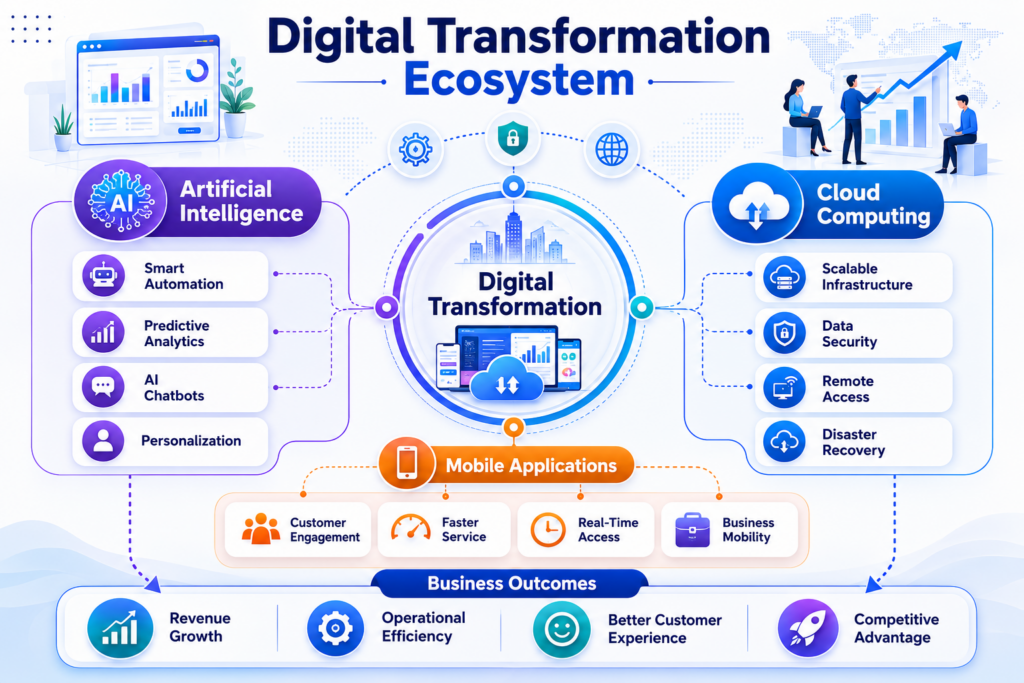
AI, cloud computing, and mobile applications form the foundation of this transformation.
How AI Business Growth Works with Cloud and Mobile Apps
The real power comes from integrating these three technologies instead of treating them as separate investments.
Together they allow businesses to:
- Collect valuable customer data
- Process information in real time
- Deliver personalized user experiences
- Automate repetitive tasks
- Scale globally with minimal infrastructure
- Improve collaboration across teams
Let’s understand each technology in detail.
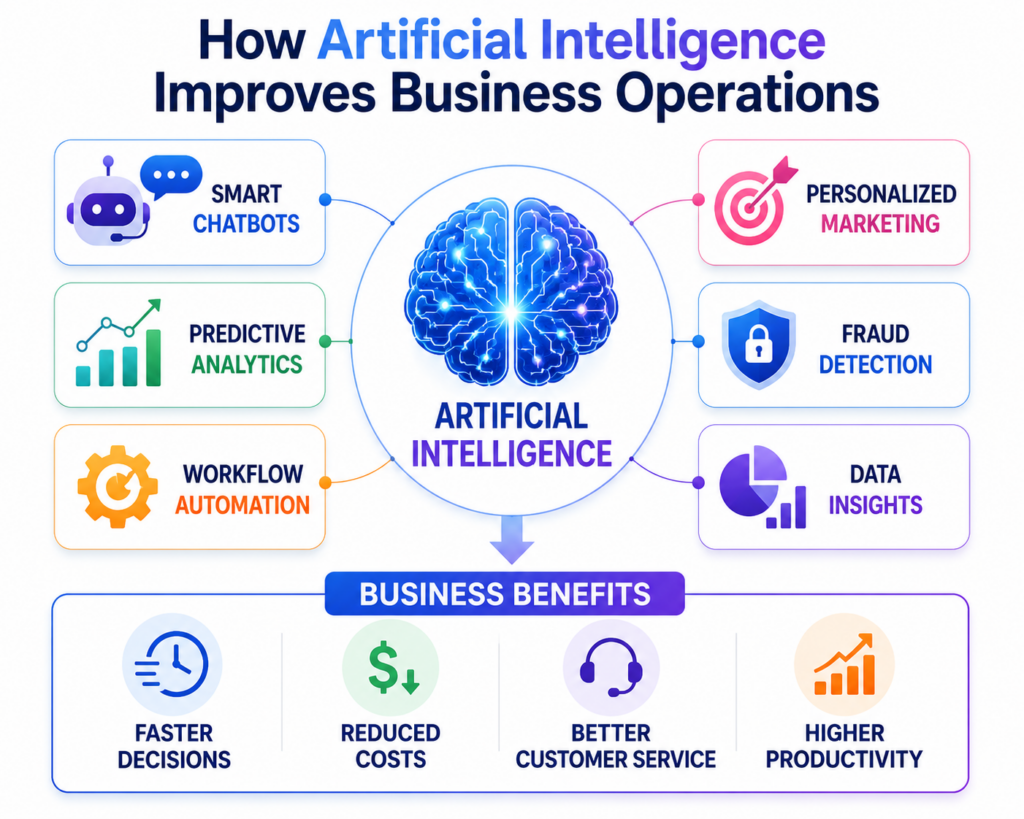
Artificial Intelligence: Turning Data into Smart Decisions
Artificial Intelligence enables businesses to automate complex processes while making faster and more accurate decisions.
Instead of relying entirely on manual analysis, AI systems learn from historical data and continuously improve their recommendations.
Key Business Benefits of AI
Intelligent Customer Support
AI-powered chatbots and virtual assistants provide 24/7 customer support by answering common questions instantly.
Benefits include:
- Reduced response time
- Lower support costs
- Higher customer satisfaction
- Better lead qualification
According to IBM’s AI resources, organizations are increasingly using AI to automate workflows while improving operational efficiency.
Predictive Analytics
Businesses generate enormous amounts of data every day.
AI helps analyze this information to predict:
- Customer buying behavior
- Product demand
- Sales trends
- Equipment maintenance
- Inventory requirements
This allows businesses to make proactive decisions rather than reacting after problems occur.
Process Automation
Many repetitive business activities can be automated using AI.
Examples include:
- Invoice processing
- Email categorization
- HR screening
- Fraud detection
- Marketing personalization
Employees can then focus on higher-value strategic work.
Personalized Customer Experiences
Modern customers expect personalized recommendations.
AI analyzes user behavior to deliver:
- Product suggestions
- Personalized marketing campaigns
- Dynamic pricing
- Customized user journeys
Companies like Netflix, Amazon, and Spotify have demonstrated how personalization increases customer engagement and retention.
Cloud Computing: The Foundation of Business Scalability
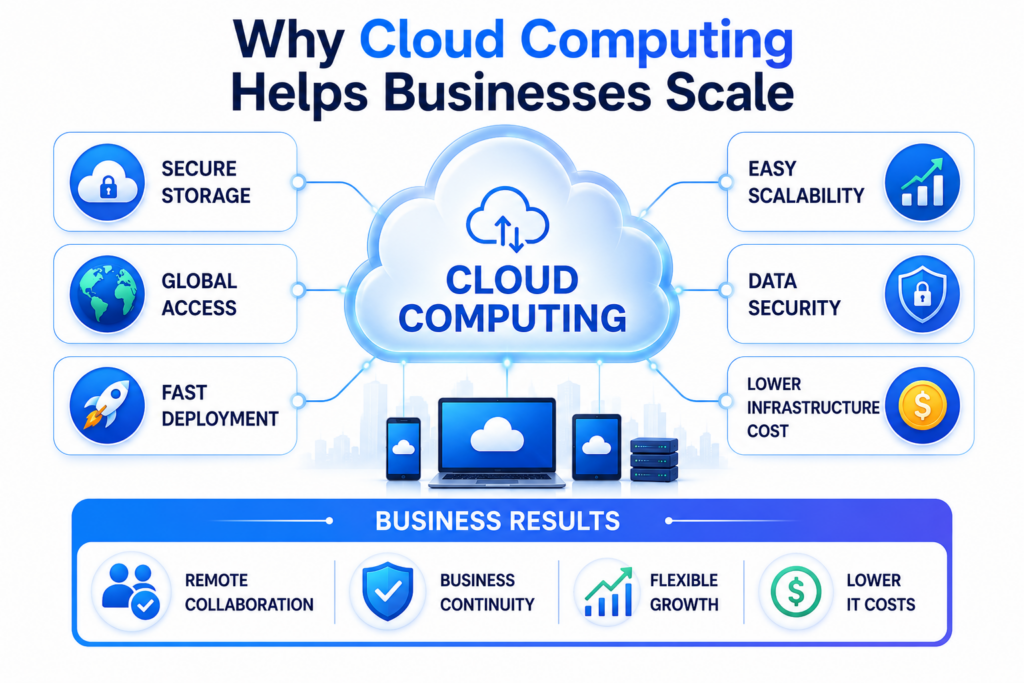
Cloud computing has fundamentally changed how businesses deploy and manage technology.
Instead of investing heavily in physical servers, organizations can access computing resources whenever needed.
Advantages of Cloud Computing
Lower Infrastructure Costs
Businesses only pay for the resources they use.
This eliminates large upfront investments in:
- Hardware
- Maintenance
- Server rooms
- Network infrastructure
Faster Deployment
Cloud platforms allow businesses to launch applications within hours instead of weeks.
Development teams can quickly:
- Test applications
- Deploy updates
- Scale services
- Recover from failures
Enhanced Security
Leading cloud providers invest billions in cybersecurity.
Businesses benefit from:
- Data encryption
- Identity management
- Backup systems
- Disaster recovery
- Continuous monitoring
Microsoft provides excellent guidance on cloud security best practices.
Business Continuity
Cloud infrastructure ensures that businesses remain operational even during unexpected disruptions.
Automatic backups and geographic redundancy significantly reduce downtime.
Global Accessibility
Employees can securely access applications and business data from anywhere.
This is especially valuable for:
- Remote teams
- Hybrid workplaces
- International businesses
Mobile Applications: Bringing Businesses Closer to Customers
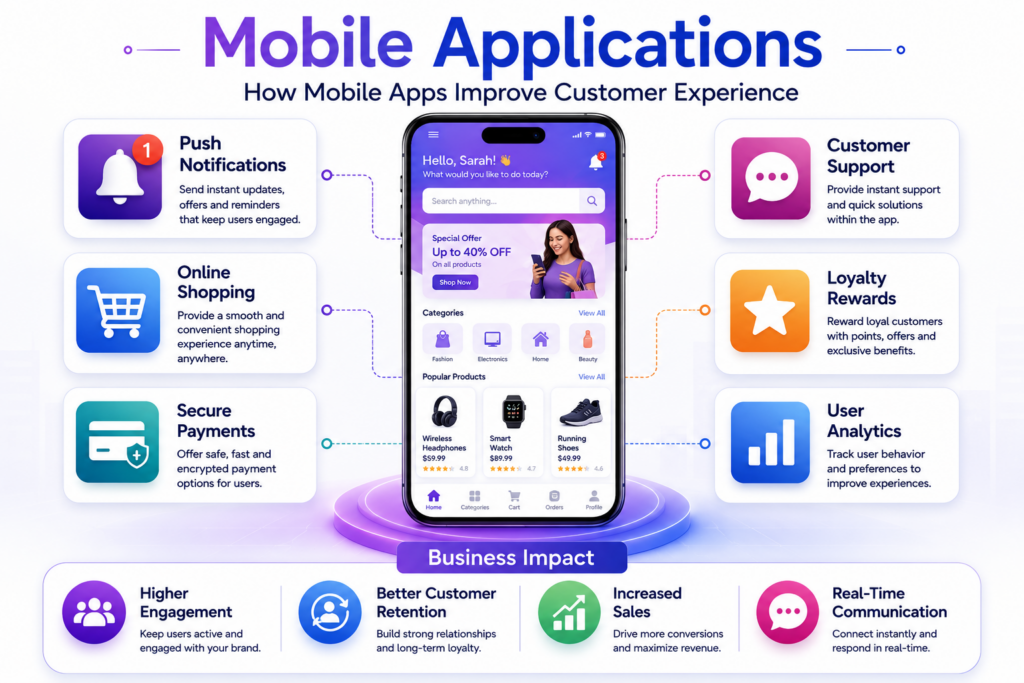
Customers spend significant time on smartphones every day.
Businesses without a strong mobile presence often lose opportunities to engage customers.
Mobile applications bridge this gap by providing convenient, personalized, and always-available digital experiences.
Why Mobile Apps Drive Business Growth
Improved Customer Engagement
Apps make communication easier through:
- Push notifications
- Loyalty programs
- Personalized offers
- Instant support
Better User Experience
Compared to websites, mobile apps generally offer:
- Faster loading
- Offline functionality
- Personalized dashboards
- Smooth navigation
This leads to higher customer retention.
Increased Revenue Opportunities
Businesses can generate revenue through:
- Online purchases
- Subscription models
- Premium features
- In-app services
Real-Time Business Insights
Mobile applications collect valuable analytics such as:
- User behavior
- Purchase history
- Session duration
- Geographic locations
- Customer preferences
These insights improve future business strategies.
Organizations considering custom mobile solutions often evaluate specialized development partners that build applications aligned with specific business goals. Resources covering mobile app development and digital solutions available through the Technobot System Blog can help businesses understand emerging trends and best practices before starting their projects.
The Power of Combining AI, Cloud, and Mobile Apps
Individually, each technology delivers measurable benefits.
Together, they create an intelligent digital ecosystem.
Imagine a retail business:
- Customers use a mobile app.
- Data is stored securely in the cloud.
- AI analyzes purchasing behavior.
- Personalized offers are generated automatically.
- Inventory updates happen in real time.
- Business dashboards provide instant insights.
This seamless integration creates faster decision-making while improving customer satisfaction.
Real-World Industry Applications
Healthcare
Healthcare organizations use:
- AI for diagnostics
- Cloud for electronic medical records
- Mobile apps for patient engagement
Benefits include improved patient care and faster diagnosis.
Retail
Retail businesses leverage:
- Personalized recommendations
- Smart inventory management
- Mobile shopping experiences
- Cloud-based analytics
Result:
Higher sales and improved customer loyalty.
Finance
Financial institutions implement:
- AI fraud detection
- Secure cloud infrastructure
- Mobile banking
This increases security while enhancing user convenience.
Manufacturing
Manufacturers use:
- Predictive maintenance
- IoT cloud platforms
- Mobile monitoring systems
This reduces downtime and operational costs.
Education
Educational institutions benefit from:
- AI tutoring
- Cloud learning platforms
- Mobile learning applications
Students receive more flexible and engaging learning experiences.
Challenges Businesses Should Prepare For
Technology adoption is not without challenges.
Organizations should plan for:
Data Security
Sensitive information must be protected using strong cybersecurity practices.
Integration Complexity
Older systems may require modernization before integrating AI and cloud services.
Employee Training
Technology is effective only when employees know how to use it efficiently.
Continuous learning remains essential.
Choosing the Right Technology Stack
Every business has unique goals.
Selecting technologies based on business requirements—not trends—is critical.
Working with experienced software development teams helps reduce implementation risks and ensures long-term scalability.
Best Practices for Successful Digital Transformation
Businesses should approach transformation strategically.
Start With Business Goals
Technology should solve business problems rather than becoming an objective itself.
Build Scalable Solutions
Choose platforms that support future growth.
Prioritize Customer Experience
Every digital initiative should improve customer interactions.
Use Data Effectively
Collect meaningful analytics and continuously optimize processes.
Invest in Security
Cybersecurity should be integrated into every stage of development.
Continuously Improve
Digital transformation is an ongoing journey rather than a one-time project.
Regular updates, monitoring, and optimization deliver long-term success.
Why Custom Solutions Deliver Better Results
Many organizations initially adopt generic software because it’s quick to implement.
However, as businesses grow, these solutions often become limiting.
Custom software provides:
- Greater flexibility
- Better scalability
- Improved security
- Easier integration
- Industry-specific workflows
- Long-term cost efficiency
Businesses evaluating custom web applications, enterprise software, cloud platforms, or mobile apps often benefit from consulting experienced development specialists capable of designing solutions around unique operational needs. Information about custom software, web development, cloud solutions, AI integration, and digital transformation services can be explored through Technobot System’s service portfolio.
The Future of Business Growth
The future belongs to organizations that embrace intelligent technology.
Emerging innovations such as:
- Generative AI
- Intelligent automation
- Edge computing
- AI-powered analytics
- Multi-cloud architecture
- Low-code development
- Internet of Things (IoT)
will continue transforming industries.
Businesses that invest today will be better positioned to compete tomorrow.
Rather than replacing human expertise, AI, cloud computing, and mobile applications enhance productivity, improve decision-making, and create better customer experiences.
Conclusion
AI Business Growth is no longer just a technology trend—it has become a critical business strategy. By combining Artificial Intelligence, cloud computing, and mobile applications, organizations can improve operational efficiency, deliver exceptional customer experiences, and build scalable digital ecosystems that support long-term success.
Artificial Intelligence enables smarter decisions, cloud computing delivers scalable infrastructure, and mobile applications strengthen customer engagement. Together, these technologies help organizations operate more efficiently, innovate faster, and respond quickly to changing market demands.
Businesses that adopt customized digital solutions aligned with their objectives are often better equipped to scale sustainably while delivering exceptional user experiences. Whether you’re modernizing existing systems or planning your next digital product, investing in the right combination of AI, cloud, and mobile technologies can create long-term value and competitive advantage.
As digital transformation continues to reshape industries, partnering with experienced technology professionals and staying informed through trusted industry resources can help organizations make confident, future-ready decisions.