

Artificial Intelligence (AI) is no longer a futuristic concept—it has become an essential part of modern business operations. From automating repetitive tasks to improving customer experiences and supporting data-driven decision-making, AI is transforming how organizations operate across industries. However, as AI adoption continues to grow, businesses must also recognize that innovation comes with responsibility.
Organizations that implement AI without proper planning may encounter challenges related to privacy, security, transparency, compliance, and ethical decision-making. Responsible AI is not just about using advanced technology; it is about ensuring that AI systems are fair, secure, reliable, and aligned with business values and customer expectations.
Businesses investing in digital transformation should consider responsible AI practices from the beginning of every project. Whether developing intelligent applications, enterprise software, or automation platforms, building AI responsibly helps organizations reduce risks while creating long-term value. Companies seeking custom AI-powered solutions often work with experienced technology partners that specialize in secure software development and scalable digital products. For example, organizations exploring enterprise AI initiatives can learn more about custom software and digital transformation solutions at Technobot System.
This guide explains the fundamentals of using AI responsibly, why it matters for businesses, common challenges, practical implementation strategies, and best practices for creating trustworthy AI systems.
What Does Using AI Responsibly Mean?
Using AI responsibly means designing, developing, deploying, and maintaining AI systems in ways that prioritize ethics, security, fairness, accountability, and compliance. Responsible AI ensures that technology benefits both businesses and users without creating unnecessary risks.
Rather than focusing only on automation or efficiency, responsible AI encourages organizations to consider the broader impact of every AI-driven decision.
Responsible AI typically includes several key principles:
- Transparency in AI decision-making
- Fairness and reduction of bias
- Protection of customer data
- Strong cybersecurity practices
- Human oversight for important decisions
- Regulatory compliance
- Continuous monitoring and improvement
These principles help businesses build AI systems that customers, employees, and stakeholders can trust.
Why Responsible AI Matters for Modern Businesses
AI can improve productivity, reduce operational costs, and uncover valuable business insights. However, poorly managed AI systems may produce biased recommendations, expose confidential information, or make decisions that are difficult to explain.
Responsible AI enables businesses to balance innovation with accountability.
Some of the biggest advantages include:
Building Customer Trust
Customers are becoming more aware of how businesses collect and use their personal data. Organizations that clearly communicate how AI supports their products and services are more likely to earn customer confidence.
Transparent AI practices also strengthen long-term customer relationships by demonstrating accountability and respect for user privacy.
Improving Business Decisions
AI models are only as good as the data they learn from. Responsible AI encourages organizations to maintain high-quality datasets, validate outputs, and continuously monitor system performance.
As a result, decision-makers receive more accurate insights that support strategic planning.
Supporting Regulatory Compliance
Governments worldwide are introducing regulations for AI governance and data protection. Businesses that establish responsible AI frameworks today will be better prepared for future legal requirements.
Following recognized frameworks such as the NIST AI Risk Management Framework can help organizations identify, assess, and manage AI-related risks effectively.
Reducing Operational Risks
Responsible AI helps organizations detect issues before they become expensive problems.
Examples include:
- Identifying biased training data
- Preventing unauthorized data access
- Monitoring unexpected AI behavior
- Improving model accuracy
- Reducing compliance risks
- Protecting business reputation
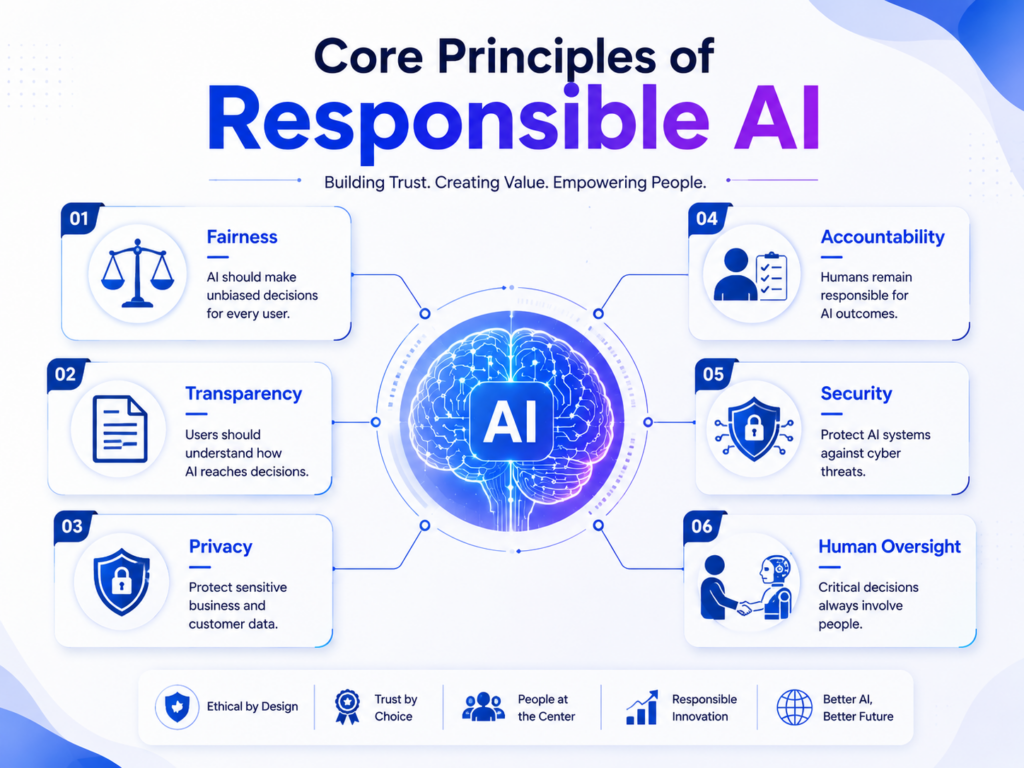
Core Principles of Responsible AI
Every successful AI initiative should be built on a strong foundation. The following principles guide organizations toward ethical and sustainable AI adoption.
Fairness
AI systems should provide consistent and unbiased outcomes for different users. Businesses should regularly evaluate datasets to identify hidden biases that could affect predictions or recommendations.
Fair AI improves customer satisfaction while reducing legal and reputational risks.
Transparency
Users deserve to understand when AI is being used and how important decisions are made.
Businesses should document:
- How AI models are trained
- What data is collected
- How predictions are generated
- Any limitations of the AI system
Providing this information increases confidence among customers and stakeholders.
Privacy and Data Protection
AI relies heavily on data, making privacy a critical responsibility.
Organizations should:
- Collect only necessary information
- Encrypt sensitive data
- Limit access to confidential records
- Follow applicable privacy regulations
- Regularly review data retention policies
Responsible data management protects both customers and the business.
Accountability
Although AI can automate many tasks, human oversight remains essential.
Businesses should clearly define who is responsible for:
- Reviewing AI decisions
- Monitoring system performance
- Handling customer concerns
- Updating AI models
- Responding to security incidents
Human accountability ensures that AI supports business operations without replacing responsible decision-making.
Security
AI systems can become targets for cyberattacks if not properly protected.
Organizations should implement:
- Multi-layer security controls
- Secure APIs
- Access management
- Continuous vulnerability assessments
- Regular software updates
Security should remain a priority throughout the AI lifecycle.
Common Challenges Businesses Face When Adopting AI Responsibly
While the benefits of AI are significant, organizations often encounter obstacles during implementation.
Poor Data Quality
Incomplete, outdated, or inaccurate data can produce unreliable AI results.
Businesses should establish strong data governance processes before deploying AI models.
Bias in Training Data
If historical datasets contain bias, AI models may unintentionally reinforce unfair outcomes.
Regular audits and diverse datasets help minimize this issue.
Lack of Explainability
Complex AI models sometimes produce decisions that are difficult to interpret.
Explainable AI techniques help organizations understand how models reach conclusions, making it easier to validate outcomes and build trust.
Security Risks
AI applications process valuable business information, making them attractive targets for attackers.
Strong cybersecurity measures should be integrated into every stage of AI development.
Best Practices for Implementing AI Responsibly
Successfully adopting AI requires more than choosing the right tools. Businesses need a clear strategy that combines technology, governance, security, and continuous improvement. The following best practices can help organizations implement using AI responsibly as part of their long-term digital transformation strategy.
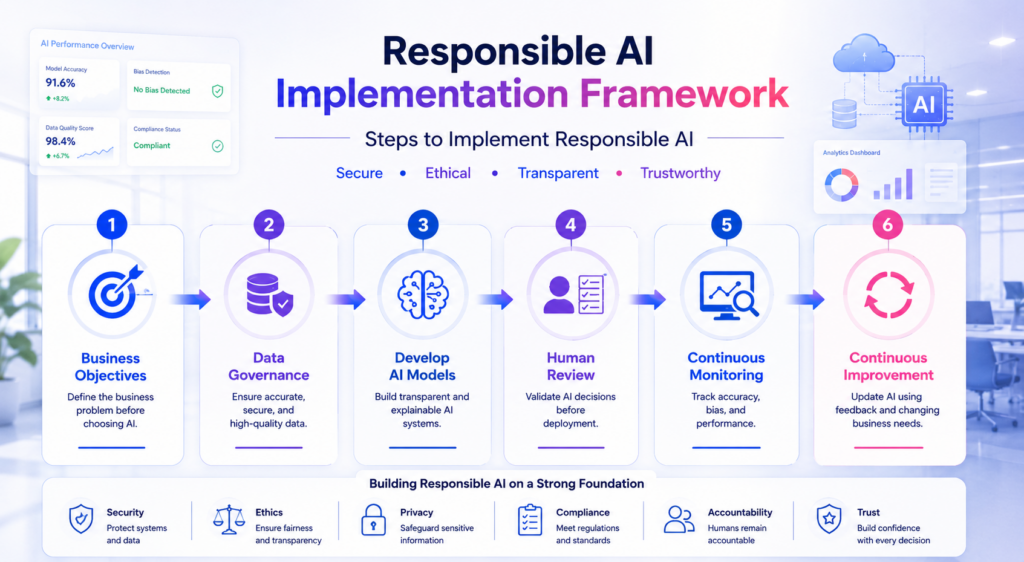
1. Define Clear Business Objectives
Before implementing AI, identify the specific business problems you want to solve.
Examples include:
- Automating customer support
- Improving demand forecasting
- Detecting fraud
- Enhancing cybersecurity
- Personalizing customer experiences
- Streamlining internal workflows
Clear objectives ensure that AI delivers measurable business value rather than becoming a technology experiment.
2. Build Strong Data Governance
Data is the foundation of every AI solution. Poor-quality data often leads to poor-quality outcomes.
An effective data governance strategy should include:
- Data quality standards
- Data ownership
- Access controls
- Data classification
- Backup and recovery policies
- Compliance monitoring
Organizations investing in enterprise software or AI-powered applications should ensure these practices are incorporated from the design stage. Businesses looking for secure and scalable development approaches can also explore insights published on the Technobot System Blog, where topics related to software development, cloud technologies, cybersecurity, and digital transformation are regularly discussed.
3. Keep Humans in the Decision Loop
AI should support human decision-making—not replace it completely.
Critical decisions involving healthcare, finance, hiring, legal matters, or cybersecurity should always include human review.
Human oversight helps:
- Validate AI recommendations
- Reduce errors
- Improve accountability
- Build customer confidence
4. Monitor AI Continuously
AI models evolve over time. Customer behavior, market conditions, and business data constantly change.
Businesses should regularly monitor:
- Prediction accuracy
- Performance metrics
- Security incidents
- Model drift
- Customer feedback
- Compliance status
Continuous monitoring allows organizations to improve AI systems while reducing operational risks.
5. Prioritize Cybersecurity
Responsible AI also means protecting AI infrastructure against cyber threats.
Security best practices include:
- Multi-factor authentication
- Encryption of sensitive data
- Secure cloud environments
- API protection
- Regular penetration testing
- Continuous vulnerability assessments
Following guidance from trusted organizations such as the OWASP Foundation helps businesses strengthen the security of AI-powered applications and web platforms.
Creating an AI Governance Framework
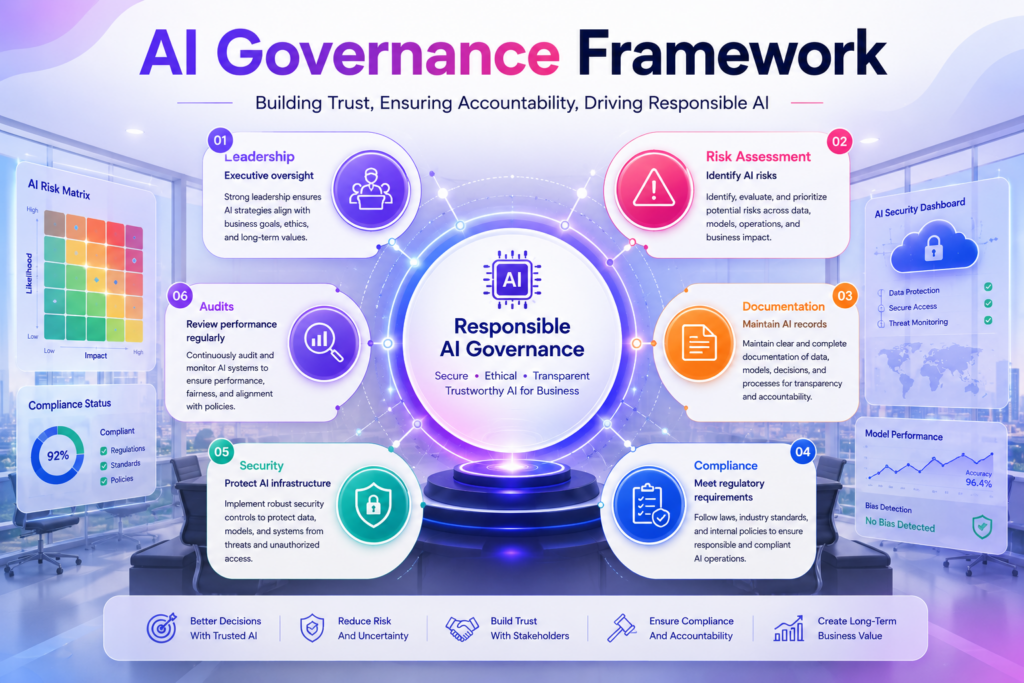
One of the most effective ways to ensure responsible AI adoption is by establishing a governance framework.
An AI governance framework defines how AI systems are designed, deployed, monitored, and maintained throughout their lifecycle.
A practical framework typically includes the following components:
Leadership and Oversight
Executive leadership should define organizational AI policies and ensure responsible AI aligns with overall business strategy.
Risk Assessment
Every AI initiative should undergo risk analysis before deployment.
Potential risks may include:
- Privacy concerns
- Security vulnerabilities
- Regulatory compliance
- Ethical considerations
- Operational reliability
Documentation
Maintain documentation for:
- Training datasets
- Model versions
- Performance evaluations
- Decision logic
- Testing procedures
- Security controls
Good documentation improves transparency and simplifies future audits.
Regular Audits
AI systems should be reviewed periodically to ensure they continue operating as intended.
Audits may evaluate:
- Fairness
- Accuracy
- Security
- Compliance
- Explainability
- Business impact
Real-World Applications of Responsible AI
Responsible AI is becoming a competitive advantage across multiple industries.
Healthcare
Healthcare organizations use AI to assist doctors with diagnosis, medical imaging, and patient care planning.
Responsible AI ensures that medical recommendations remain transparent, secure, and supported by healthcare professionals.
Financial Services
Banks use AI for:
- Fraud detection
- Credit risk analysis
- Customer support
- Regulatory reporting
Responsible AI helps financial institutions reduce bias while maintaining compliance.
Retail and E-commerce
Retail businesses use AI to recommend products, forecast inventory, and personalize customer experiences.
Responsible implementation protects customer privacy while improving shopping experiences.
Manufacturing
Manufacturers apply AI for:
- Predictive maintenance
- Quality inspection
- Production optimization
- Supply chain management
Responsible AI improves efficiency without compromising operational safety.
Common Mistakes Businesses Should Avoid
Many organizations adopt AI quickly but overlook important governance practices.
Common mistakes include:
- Deploying AI without clear objectives
- Ignoring data quality issues
- Failing to monitor model performance
- Over-automating critical decisions
- Neglecting cybersecurity
- Assuming AI outputs are always correct
- Not documenting AI processes
- Overlooking employee training
Avoiding these mistakes significantly improves long-term AI success.
The Future of Responsible AI
Artificial intelligence will continue evolving rapidly.
Emerging trends include:
- Explainable AI (XAI)
- AI governance platforms
- Privacy-preserving machine learning
- Federated learning
- AI risk management tools
- Industry-specific AI regulations
- Responsible generative AI practices
Organizations that invest in responsible AI today will be better positioned to adapt to future technologies and regulatory requirements.
At the same time, businesses will increasingly seek technology partners capable of delivering secure, scalable, and ethical AI-powered solutions. Companies planning custom software, AI integration, enterprise web platforms, or digital transformation initiatives can explore professional development services through Technobot System, where modern software engineering practices support long-term business growth.
Conclusion
Artificial intelligence is transforming the way businesses operate, innovate, and compete. However, the true value of AI is realized only when it is implemented responsibly.
Using AI responsibly means building systems that are transparent, secure, fair, and accountable. It requires organizations to combine advanced technology with strong governance, quality data, human oversight, and continuous monitoring.
Businesses that prioritize responsible AI are more likely to earn customer trust, improve operational efficiency, strengthen cybersecurity, and remain prepared for future regulations. Rather than viewing responsible AI as an additional requirement, organizations should see it as a strategic investment that supports sustainable innovation and long-term success.
As AI continues to reshape industries, businesses that embrace ethical and responsible practices today will be better equipped to create reliable digital solutions, build lasting customer relationships, and unlock the full potential of artificial intelligence.