Businesses are no longer competing only on products and prices. They are competing on how quickly they can understand customers, deliver services, automate repetitive work, and provide seamless digital experiences. This shift has made three technologies especially important: artificial intelligence (AI), cloud computing, and mobile applications.
Individually, each technology can create significant value. However, when they work together, their impact becomes much greater. The powerful combination of AI, cloud, and mobile apps allows businesses to build intelligent, scalable, and highly accessible digital products that can adapt to changing customer and operational needs.
A mobile application provides the user-facing experience. Cloud infrastructure supplies scalable computing, storage, databases, and connectivity. AI adds intelligence by helping applications analyze information, recognize patterns, make predictions, and deliver personalized experiences.
For businesses exploring this combination, working with an experienced IT service provider for custom digital solutions can help turn a technology concept into a practical application aligned with specific business requirements.
The result is more than just a mobile application. It can become an intelligent digital ecosystem capable of continuously learning from data, responding to users, and scaling as the organization grows.
Understanding the AI, Cloud, and Mobile App Connection
Before exploring the benefits, it is important to understand what each technology contributes.
What AI Brings to Mobile Applications
Artificial intelligence allows applications to perform tasks that traditionally required human judgment or extensive manual processing.
Depending on the business use case, AI can support:
- Personalized recommendations
- Natural language interactions
- Predictive analytics
- Image and document recognition
- Fraud detection
- Customer behavior analysis
- Intelligent search
- Automated categorization
- Sentiment analysis
- Forecasting and decision support
For example, an e-commerce application can use AI to analyze browsing and purchasing behavior and recommend products that are more relevant to each customer.
Similarly, a financial application could analyze transaction patterns to identify potentially unusual activity.
What Cloud Computing Contributes
Cloud computing provides the infrastructure needed to operate modern applications without requiring businesses to maintain all computing resources themselves.
Cloud platforms can provide:
- Scalable computing power
- Cloud databases
- File and object storage
- Application hosting
- APIs and backend services
- Data processing
- Security and access controls
- Monitoring and analytics infrastructure
According to NIST’s definition of cloud computing, cloud computing enables convenient, on-demand access to shared computing resources that can be rapidly provisioned and released.
This scalability becomes particularly valuable when an AI-powered mobile application experiences sudden increases in traffic.
What Mobile Apps Contribute
Mobile applications bring the technology directly to users.
Smartphones can provide businesses with an always-available channel for:
- Customer engagement
- Digital payments
- Booking and reservations
- Product discovery
- Communication
- Notifications
- Location-based services
- Account management
- Employee workflows
Therefore, the three technologies complement each other naturally.
Mobile apps connect users. Cloud connects systems and data. AI makes the experience intelligent.
Why the Combination Is More Powerful Than Using One Technology Alone
Using AI without cloud infrastructure can make scaling difficult. Using cloud computing without intelligent functionality may leave businesses with infrastructure that is powerful but underutilized. Meanwhile, a mobile application without a strong backend can struggle to provide reliable and personalized experiences.
When the three technologies are integrated, they create a connected architecture.
Consider a food delivery application.
The mobile application allows customers to browse restaurants and place orders. Cloud services manage accounts, orders, payments, restaurant information, and delivery data. AI can then analyze historical information to improve restaurant recommendations, estimate delivery demand, detect unusual transactions, and personalize the customer’s experience.
Each component has a different responsibility, but together they create a much stronger product.
How AI, Cloud, and Mobile Apps Work Together
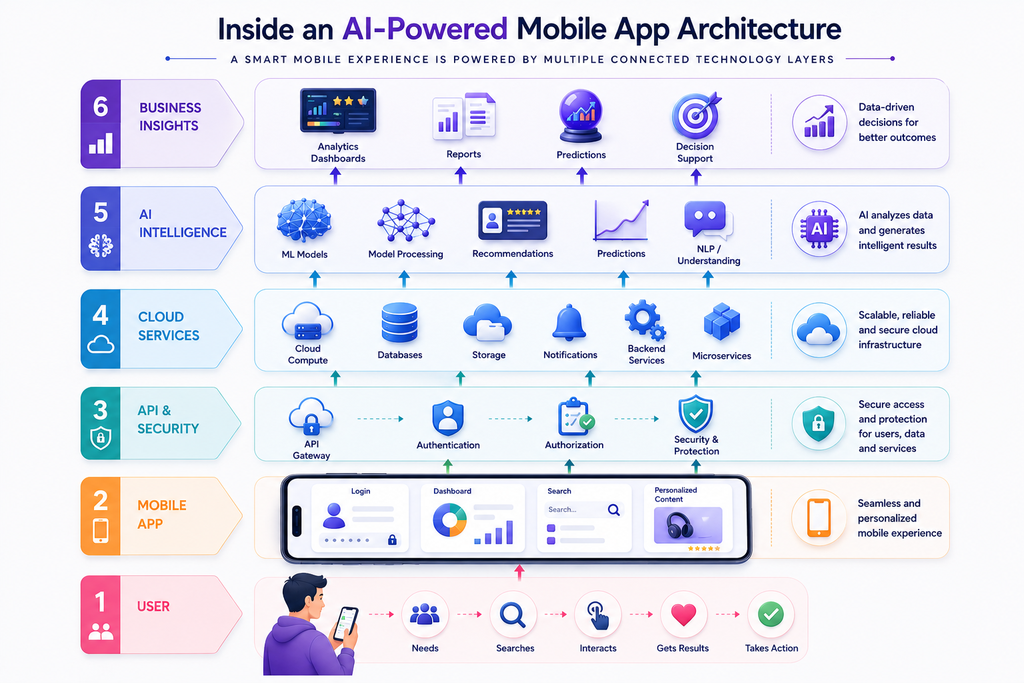
A typical architecture can be visualized as a continuous flow:
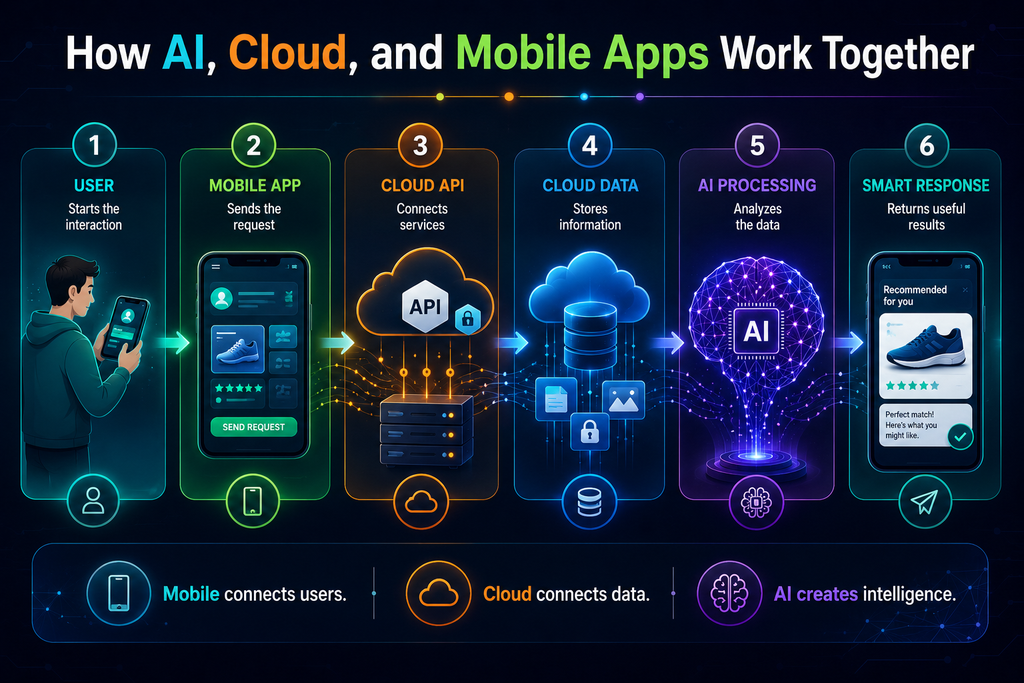
Mobile App → Cloud APIs → Cloud Data → AI Processing → Intelligent Response → Mobile App
For example:
- A customer opens a mobile application.
- The application sends a request to a cloud-based API.
- The backend retrieves relevant information from cloud databases.
- An AI service analyzes the request or available data.
- The system generates an intelligent response.
- The mobile application presents the result to the user.
This process can happen within seconds.
Cloud as the Central Technology Layer
The cloud often acts as the central infrastructure connecting the mobile application with databases, APIs, AI services, analytics systems, and third-party integrations.
This architecture can make it easier to:
- Scale backend resources
- Manage large datasets
- Integrate external services
- Deploy updates
- Monitor application performance
- Support multiple application versions
It also makes it possible to separate the mobile interface from the backend logic, allowing development teams to improve individual components without rebuilding the entire product.
Key Business Benefits of Combining AI, Cloud, and Mobile Apps
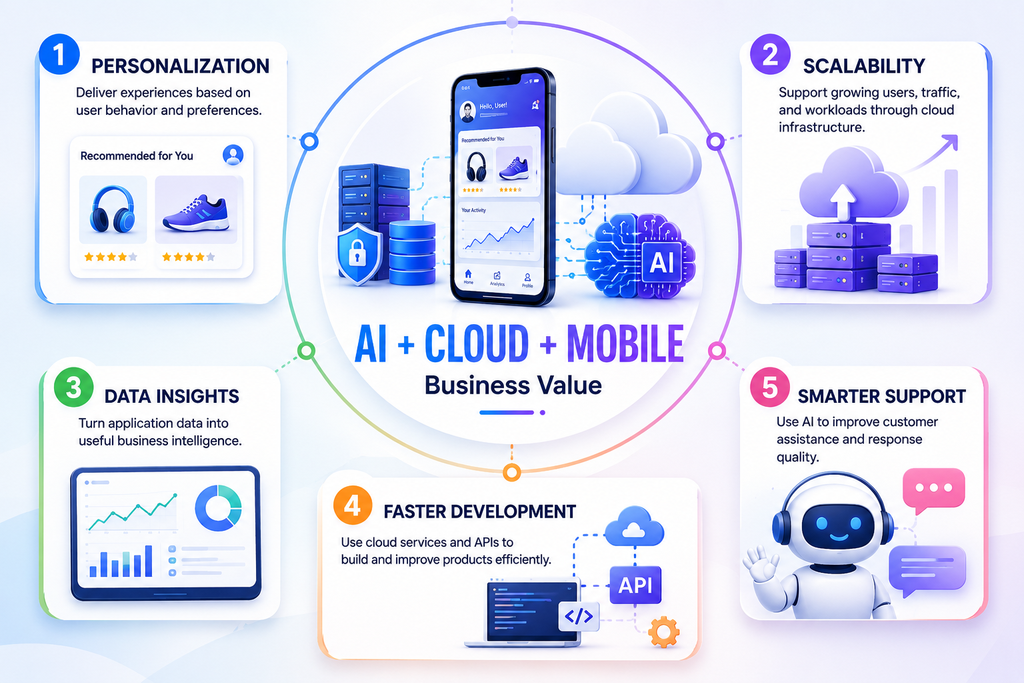
1. Personalized Customer Experiences
Modern customers expect digital products to understand their needs.
AI can analyze user interactions and behavioral patterns to provide more relevant experiences.
For example, a retail application can recommend products based on previous purchases, browsing activity, preferences, and contextual information.
Personalization can also be applied to:
- Content
- Notifications
- Offers
- Search results
- Product recommendations
- Customer support
The cloud makes it possible to process and store the underlying data at scale, while the mobile application delivers the personalized experience directly to the customer.
2. Better Business Decision-Making
Mobile applications generate valuable operational and customer data.
When this information is securely collected and processed through cloud infrastructure, AI can identify patterns that may not be obvious through manual analysis.
Businesses can use these insights for:
- Demand forecasting
- Customer segmentation
- Sales analysis
- Inventory planning
- Risk assessment
- Performance monitoring
- Operational optimization
Instead of simply collecting data, organizations can turn it into actionable intelligence.
3. Improved Scalability
One of the biggest advantages of cloud infrastructure is scalability.
A mobile application may have a few hundred users when it launches but potentially thousands or millions later.
Cloud infrastructure can support changing workloads by allowing organizations to scale resources according to demand.
This is particularly important for AI-powered applications because AI workloads can require significant processing resources.
A properly designed architecture can separate application traffic from AI workloads and scale each component according to its requirements.
4. Faster Product Development
Cloud services and modern development frameworks can reduce the amount of infrastructure developers need to build from scratch.
Instead of creating every backend component internally, development teams can integrate managed services for databases, authentication, storage, monitoring, messaging, and AI functionality.
This allows teams to focus more on business-specific functionality.
Custom application development becomes especially valuable when standard software cannot meet a company’s unique workflow or customer requirements.
5. Intelligent Customer Support
AI-powered mobile applications can provide customers with faster access to information.
For example, a customer service application could help users:
- Find answers to common questions
- Track service requests
- Search documentation
- Check order information
- Understand account activity
- Receive contextual recommendations
Cloud infrastructure allows customer information and application data to be securely accessed when required, while AI can interpret user requests and provide appropriate responses.
However, organizations should still establish clear security, privacy, and human escalation processes for sensitive use cases.
Real-World Use Cases
The combination of these technologies can support many industries.
Healthcare
Healthcare applications can use cloud infrastructure to manage data and AI to assist with pattern recognition, scheduling, documentation, and patient engagement.
Mobile applications can provide patients with access to appointments, reminders, reports, and communication tools.
Sensitive healthcare applications must, however, be designed around applicable privacy, security, and regulatory requirements.
Retail and E-Commerce
Retail businesses can use AI, cloud, and mobile apps for:
- Product recommendations
- Personalized promotions
- Inventory visibility
- Customer analytics
- Demand forecasting
- Intelligent search
- Customer support
A mobile application becomes the customer interface, while cloud services connect products, orders, customer data, and analytics.
Banking and Financial Services
Financial applications can use AI to identify unusual transaction patterns, analyze customer behavior, and improve personalization.
Cloud infrastructure can support scalable application services, while mobile apps provide customers with real-time access to accounts and financial services.
Security should remain a primary design consideration because financial applications process highly sensitive information.
Logistics and Transportation
AI can analyze delivery patterns, traffic information, demand, and historical data to support better operational decisions.
Mobile applications can provide drivers and customers with real-time information, while cloud systems coordinate orders, routes, tracking, and business operations.
Education
Educational applications can combine AI-powered personalization with cloud-based learning platforms.
For example, an application could analyze learning activity and recommend appropriate resources.
Cloud infrastructure can store course content and learning records, while the mobile application gives students convenient access.
Designing an AI-Powered Cloud Mobile Application
Building this type of product requires more than adding AI to an existing application.
Step 1: Define the Business Problem
Start with the business objective rather than the technology.
Ask:
- What problem are we solving?
- Who will use the application?
- What process needs improvement?
- What data is available?
- Where can AI provide measurable value?
Not every application needs advanced AI.
A focused AI feature that solves a real customer problem can be more valuable than adding AI everywhere.
Step 2: Design the Mobile Experience
The user interface should remain simple even when the underlying technology is complex.
Users should not need to understand how AI or cloud infrastructure works.
The application should provide:
- Clear navigation
- Fast responses
- Accessible interfaces
- Useful notifications
- Consistent interactions
- Appropriate error handling
Step 3: Build a Scalable Cloud Backend
The backend should be designed around the application’s expected workload.
Important components can include:
- API services
- Authentication
- Databases
- Cloud storage
- Monitoring
- Logging
- Background processing
- Integration services
The architecture should also consider future growth instead of only supporting the initial launch.
Step 4: Introduce AI Where It Creates Value
AI should solve a clearly defined problem.
For example, instead of simply adding an AI assistant because it is popular, a business could use AI to reduce customer support response times or improve product discovery.
This approach makes AI investment easier to measure.
Security and Privacy Should Be Built Into the Architecture
The combination of AI, cloud, and mobile technology also creates security responsibilities.
Applications may process customer profiles, business records, payment information, location information, and behavioral data.
Therefore, organizations should consider:
- Strong authentication
- Role-based access controls
- Data encryption
- Secure API design
- Secure mobile storage
- Cloud configuration security
- Logging and monitoring
- Regular security testing
- Data minimization
- Appropriate data retention policies
The OWASP Mobile Application Security project provides useful guidance on common mobile application security risks.
AI systems also introduce additional considerations. Businesses should understand what data is sent to AI services, how it is processed, how access is controlled, and whether sensitive information is appropriately protected.
Security should not be treated as a final-stage feature. It should be considered throughout application design and development.
Challenges Businesses Should Prepare For
Although the powerful combination of AI, cloud, and mobile apps creates major opportunities, it also introduces challenges.
Data Quality
AI depends heavily on the quality of available data.
Incomplete, outdated, duplicated, or biased data can reduce the usefulness of AI-generated insights.
Integration Complexity
Connecting mobile applications, cloud services, databases, AI models, payment systems, analytics platforms, and third-party APIs can create architectural complexity.
A clear system design is therefore essential.
Cost Management
Cloud resources and AI processing can become expensive if workloads are not monitored.
Organizations should track:
- Compute usage
- Storage
- API requests
- AI inference costs
- Data transfer
- Database consumption
Cost optimization should be part of the architecture from the beginning.
AI Accuracy
AI-generated results are not automatically correct.
Businesses should define appropriate validation mechanisms, particularly for decisions involving finance, healthcare, legal matters, security, or other high-impact areas.
User Trust
Customers need to understand how their information is used.
Transparent privacy practices, appropriate consent mechanisms, and clear communication can help organizations build long-term trust.
The Future of AI, Cloud, and Mobile Applications
The relationship between these technologies is likely to become even stronger.
Mobile devices are increasingly becoming intelligent interfaces to cloud-based services. At the same time, AI capabilities are becoming easier to integrate into business applications.
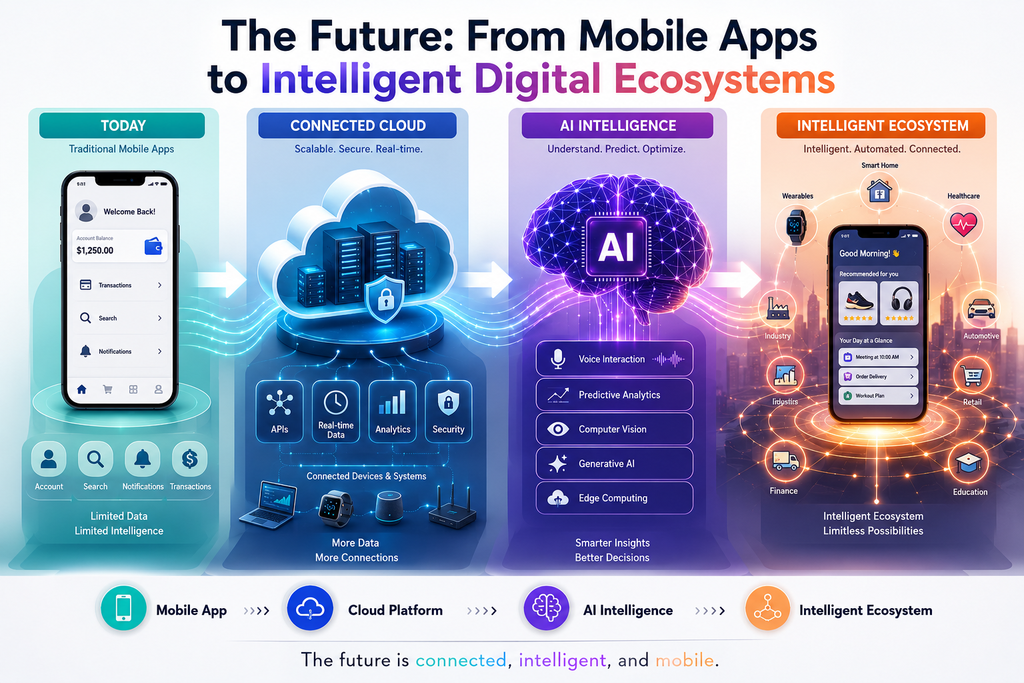
Future applications may increasingly combine:
- Generative AI
- Predictive analytics
- Voice interfaces
- Computer vision
- Edge computing
- Real-time analytics
- IoT connectivity
- Context-aware experiences
This could enable applications to respond more intelligently to user behavior and environmental conditions.
For example, a field-service application could analyze equipment information, historical maintenance records, technician activity, and real-time sensor data to recommend the next maintenance action.
The mobile application provides the interface. Cloud infrastructure coordinates the data. AI produces the intelligence.
That is the real strategic value of the technology combination.
How Businesses Can Start
Companies do not need to transform their entire technology environment overnight.
A practical approach is to start with one high-value use case.
For example:
- Identify a repetitive or data-heavy business process.
- Determine whether mobile access would improve the experience.
- Identify the data required to support the process.
- Select appropriate cloud infrastructure.
- Introduce AI only where it provides measurable value.
- Build a small proof of concept.
- Test the experience with real users.
- Measure performance and business outcomes.
- Improve the product based on feedback.
- Scale the architecture as adoption increases.
This incremental approach can reduce unnecessary investment while creating a clear path toward a larger digital transformation strategy.
Businesses looking for custom application development can also explore custom IT and software development solutions to evaluate how application, cloud, and intelligent technology can be combined around their specific requirements.
Why Custom Development Can Matter
Off-the-shelf applications are useful for common business requirements. However, every organization has unique workflows, customers, data, and operational challenges.
A custom application can be designed around those specific requirements.
For example, a company may need a mobile platform that combines:
- Custom customer accounts
- Cloud-based business data
- AI-powered recommendations
- Internal dashboards
- Third-party integrations
- Automated notifications
- Role-based access
- Analytics
Instead of forcing the business to adapt to generic software, custom development allows the technology to adapt to the business.
This is particularly useful when the application itself becomes an important part of the organization’s competitive advantage.
Conclusion
The powerful combination of AI, cloud, and mobile apps is changing how businesses design digital products and interact with customers.
Mobile applications provide convenient access and engagement. Cloud computing provides scalable infrastructure and connectivity. AI adds intelligence that can improve personalization, automation, analytics, and decision-making.
The greatest opportunity comes from treating these technologies as connected parts of one digital strategy rather than separate projects.
Businesses that begin with a clear problem, design a scalable architecture, protect user data, and introduce AI where it creates genuine value can build applications that are not only technologically advanced but also commercially useful.
As digital expectations continue to rise, the organizations that combine intelligent software, scalable cloud infrastructure, and accessible mobile experiences will be better positioned to create faster, smarter, and more personalized digital services.
For businesses evaluating their next custom technology project, exploring experienced IT and custom software development services can be a practical starting point for turning these technologies into a solution designed around real business needs.