In today’s rapidly evolving digital landscape, businesses are no longer relying on a single cloud provider to manage their infrastructure. Instead, they are increasingly adopting a multi-cloud strategy to enhance flexibility, performance, and resilience. As organizations scale their digital operations, leveraging multiple cloud environments has become a strategic necessity rather than a technical choice.
Modern IT service providers—such as those offering custom application development and scalable cloud solutions—are helping businesses design tailored multi-cloud architectures that align with their operational goals. However, while the advantages are significant, implementing a multi-cloud strategy also introduces a unique set of challenges that organizations must carefully navigate.
This blog explores the benefits and challenges of a multi-cloud strategy, providing practical insights for decision-makers, developers, and IT leaders.
What is a Multi-Cloud Strategy?
A multi-cloud strategy refers to the use of two or more cloud computing platforms (such as AWS, Microsoft Azure, or Google Cloud) within a single architecture. Instead of relying on a single provider, organizations distribute workloads across multiple environments.
Why Businesses Are Moving to Multi-Cloud
Several factors are driving the adoption of multi-cloud strategies:
- Avoiding vendor lock-in
- Improving system reliability
- Optimizing performance across regions
- Enhancing data compliance and governance
- Leveraging best-in-class services from different providers
As a result, companies are building more dynamic and resilient infrastructures that can adapt to changing business demands.
Key Benefits of a Multi-Cloud Strategy
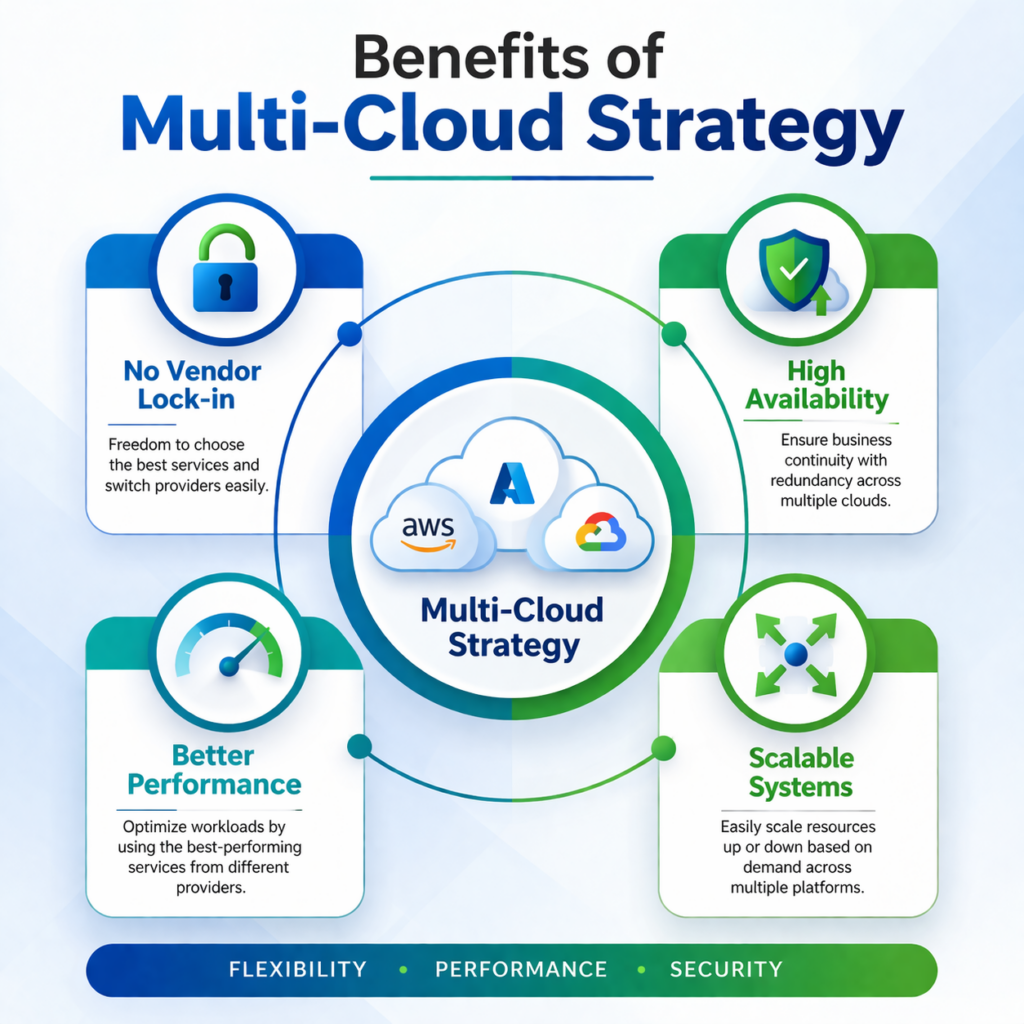
Adopting a multi-cloud strategy offers a wide range of benefits that directly impact performance, scalability, and business continuity.
1. Avoiding Vendor Lock-In
One of the biggest advantages of a multi-cloud strategy is freedom from vendor dependency. Organizations are not tied to a single provider’s pricing, policies, or technical limitations.
This flexibility allows businesses to:
- Switch providers when needed
- Negotiate better pricing
- Use specialized services from different vendors
2. Improved Reliability and Redundancy
Relying on a single cloud provider increases the risk of downtime. However, a multi-cloud strategy ensures that workloads can be distributed across multiple platforms.
For example:
- If one provider experiences downtime, others can take over
- Critical applications remain accessible
- Disaster recovery becomes more efficient
According to insights from Google Cloud Architecture Framework, distributing workloads across regions and providers significantly improves system resilience.
3. Performance Optimization
Different cloud providers excel in different areas. A multi-cloud strategy allows organizations to choose the best platform for each workload.
For instance:
- One provider may offer better AI/ML services
- Another may provide superior database performance
- A third may have lower latency in specific regions
This results in optimized performance and better user experience.
4. Enhanced Security and Compliance
Multi-cloud environments help organizations meet regulatory requirements by storing data across multiple geographic locations.
Benefits include:
- Improved data sovereignty
- Compliance with regional laws (e.g., GDPR)
- Reduced risk of data breaches
Additionally, organizations can implement layered security practices across platforms.
5. Scalability and Flexibility
A multi-cloud strategy provides unmatched scalability. Businesses can dynamically allocate resources based on demand.
This is particularly useful for:
- High-traffic applications
- Seasonal workloads
- Rapidly growing startups
In many cases, teams that explore advanced topics like cloud scalability and automation—often discussed in modern IT blogs on DevOps and infrastructure—gain deeper insights into optimizing such environments.
Common Multi-Cloud Use Cases
Organizations across industries are leveraging multi-cloud strategies for various use cases:
1. Disaster Recovery
Using multiple cloud providers ensures that backups are available even if one provider fails.
2. Application Portability
Applications can be moved between providers without major disruptions.
3. Data Analytics
Different platforms offer unique analytics tools, enabling more powerful insights.
4. Cost Optimization
Businesses can choose cost-effective services from different providers.
Challenges of a Multi-Cloud Strategy
While the benefits are compelling, a multi-cloud strategy is not without its complexities. Organizations must address several challenges to ensure successful implementation.
1. Increased Complexity
Managing multiple cloud environments can be complicated. Each provider has its own:
- Interface
- APIs
- Security protocols
- Billing structures
This complexity can overwhelm teams without proper expertise.
2. Security Management Issues
Although multi-cloud improves security in some ways, it also introduces new risks.
Challenges include:
- Managing multiple security policies
- Ensuring consistent access control
- Monitoring threats across platforms
Organizations must implement centralized security frameworks to maintain control.
3. Data Integration and Interoperability
Data consistency across multiple platforms is a major concern.
Issues may include:
- Data synchronization delays
- Compatibility challenges
- Increased latency
To address this, businesses often rely on APIs and middleware solutions.
4. Cost Management Difficulties
While multi-cloud can reduce costs, poor management can lead to overspending.
Common problems:
- Lack of visibility into usage
- Unexpected charges
- Inefficient resource allocation
Using cost monitoring tools and clear budgeting strategies is essential.
5. Skill Gap and Talent Requirements
A successful multi-cloud strategy requires skilled professionals who understand multiple platforms.
Organizations need:
- Cloud architects
- DevOps engineers
- Security specialists
Without the right expertise, implementation can fail or become inefficient.
Best Practices for Implementing a Multi-Cloud Strategy
To maximize the benefits and minimize challenges, organizations should follow proven best practices.
1. Define Clear Objectives
Start by identifying:
- Business goals
- Performance requirements
- Compliance needs
A clear roadmap ensures alignment between IT and business strategies.
2. Use Cloud-Agnostic Tools
Adopt tools and frameworks that work across multiple platforms, such as:
- Kubernetes
- Terraform
- Docker
These tools simplify deployment and management.
3. Implement Centralized Monitoring
Use monitoring tools that provide visibility across all cloud environments.
For example, solutions recommended by platforms like AWS Well-Architected Framework help ensure performance, reliability, and security.
4. Strengthen Security Practices
Security should be a top priority in any multi-cloud strategy.
Key steps:
- Implement identity and access management (IAM)
- Use encryption across all platforms
- Enable multi-factor authentication (MFA)
5. Optimize Cost Management
Regularly analyze cloud usage and optimize resource allocation.
Best practices include:
- Automated scaling
- Budget tracking
- Resource tagging
6. Partner with Experienced IT Teams
Working with experienced IT service providers can significantly simplify multi-cloud adoption. Teams that specialize in custom software and cloud architecture—such as those offering end-to-end IT solutions and cloud integration services—can design scalable and efficient infrastructures tailored to business needs.
Multi-Cloud vs Hybrid Cloud: Key Differences
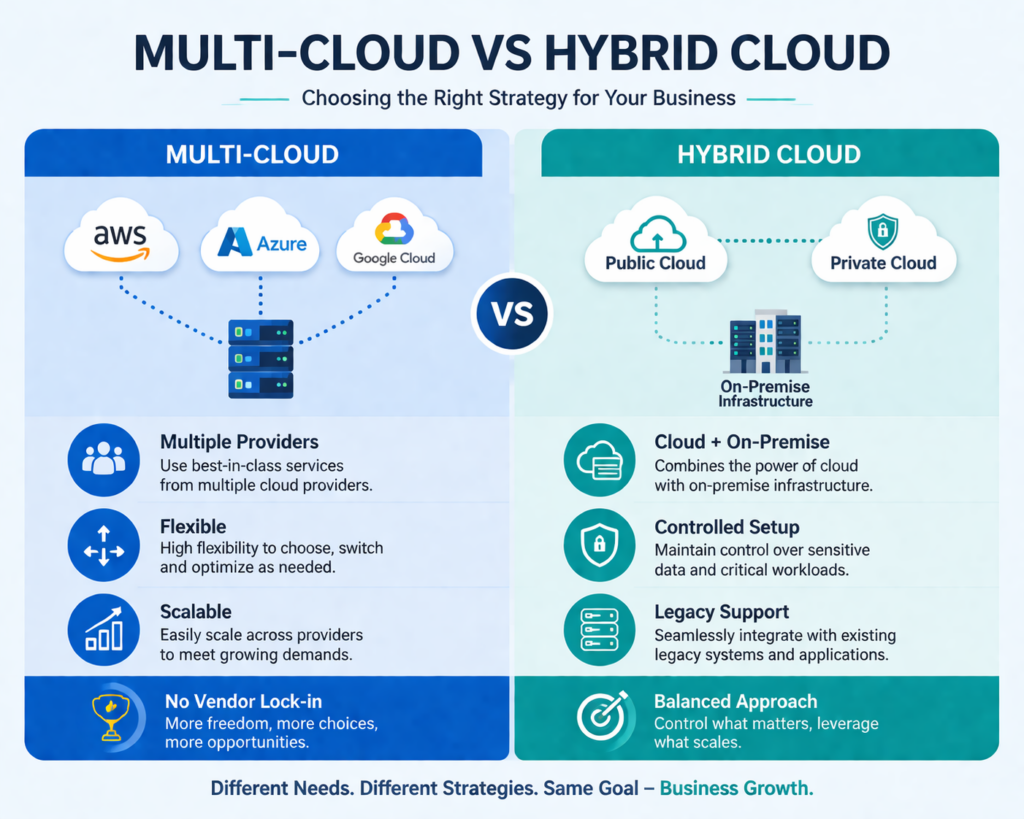
Many people confuse multi-cloud with hybrid cloud, but they are not the same.
| Feature | Multi-Cloud | Hybrid Cloud |
|---|---|---|
| Definition | Multiple cloud providers | Combination of cloud + on-premise |
| Flexibility | High | Moderate |
| Complexity | Higher | Moderate |
| Use Case | Avoid vendor lock-in | Integrate legacy systems |
Understanding this distinction helps organizations choose the right strategy.
Future of Multi-Cloud Strategy
The future of cloud computing is increasingly multi-cloud. As businesses continue to innovate, multi-cloud strategies will evolve with new technologies such as:
- Artificial Intelligence (AI) integration
- Edge computing
- Serverless architectures
- Advanced automation
Moreover, organizations are moving toward cloud-native development, where applications are designed specifically for multi-cloud environments.
This trend highlights the importance of staying updated with evolving technologies and adopting scalable architectures.
Conclusion
A multi-cloud strategy is no longer just an option—it is becoming a necessity for businesses aiming to stay competitive in a digital-first world. By leveraging multiple cloud providers, organizations can achieve greater flexibility, improved performance, and enhanced resilience.
However, the journey is not without challenges. From increased complexity to security concerns, businesses must adopt a strategic approach to implementation. By following best practices, investing in the right tools, and collaborating with experienced IT professionals, organizations can successfully navigate the multi-cloud landscape.
Ultimately, a well-executed multi-cloud strategy empowers businesses to innovate faster, scale efficiently, and deliver superior user experiences in an increasingly connected world.