In today’s highly competitive digital landscape, speed is not just an advantage—it is a necessity. Businesses that can deliver high-quality software faster consistently outperform their competitors. This is where the role of DevOps in faster product delivery becomes critical. By integrating development and operations, DevOps eliminates traditional bottlenecks and enables organizations to release products efficiently without compromising quality.
Modern IT service providers offering custom application development solutions have increasingly adopted DevOps practices to streamline workflows, enhance collaboration, and ensure rapid delivery cycles. As a result, businesses can bring innovative ideas to market faster while maintaining reliability and scalability.
This blog explores how DevOps accelerates product delivery, its key practices, tools, and the real-world benefits it brings to modern software development.
What is DevOps?
DevOps is a combination of cultural philosophies, practices, and tools that aims to unify software development (Dev) and IT operations (Ops). Traditionally, development and operations teams worked in silos, which often led to delays, miscommunication, and inefficiencies.
However, DevOps bridges this gap by promoting collaboration, automation, and continuous delivery.
Key Principles of DevOps
- Collaboration and Communication between teams
- Automation of repetitive tasks such as testing and deployment
- Continuous Integration and Continuous Delivery (CI/CD)
- Monitoring and feedback loops
- Infrastructure as Code (IaC)
These principles form the backbone of the role of DevOps in faster product delivery, enabling teams to deliver updates quickly and reliably.
Why Faster Product Delivery Matters
Before diving deeper, it’s important to understand why speed matters in software development.
Business Benefits of Faster Delivery
- Improved Time-to-Market
- Enhanced Customer Satisfaction
- Rapid Innovation and Experimentation
- Competitive Advantage
- Faster Feedback and Iteration
Companies that adopt DevOps can quickly respond to market changes and customer needs. For example, frequent releases allow businesses to test features, gather feedback, and improve continuously.
According to the State of DevOps Report by Google Cloud, high-performing DevOps teams deploy code significantly more frequently and recover from failures faster than traditional teams.
The Role of DevOps in Faster Product Delivery
The role of DevOps in faster product delivery goes beyond just speeding up deployments. It transforms the entire software development lifecycle.
1. Continuous Integration and Continuous Delivery (CI/CD)
CI/CD pipelines are central to DevOps.
- Continuous Integration (CI): Developers frequently merge code changes into a shared repository. Automated tests validate these changes.
- Continuous Delivery (CD): Code changes are automatically prepared for release to production.
Benefits:
- Reduced integration issues
- Faster release cycles
- Improved code quality
By automating builds and tests, teams can detect and fix issues early, ensuring smoother delivery.
2. Automation of Processes
Automation is one of the strongest pillars of DevOps.
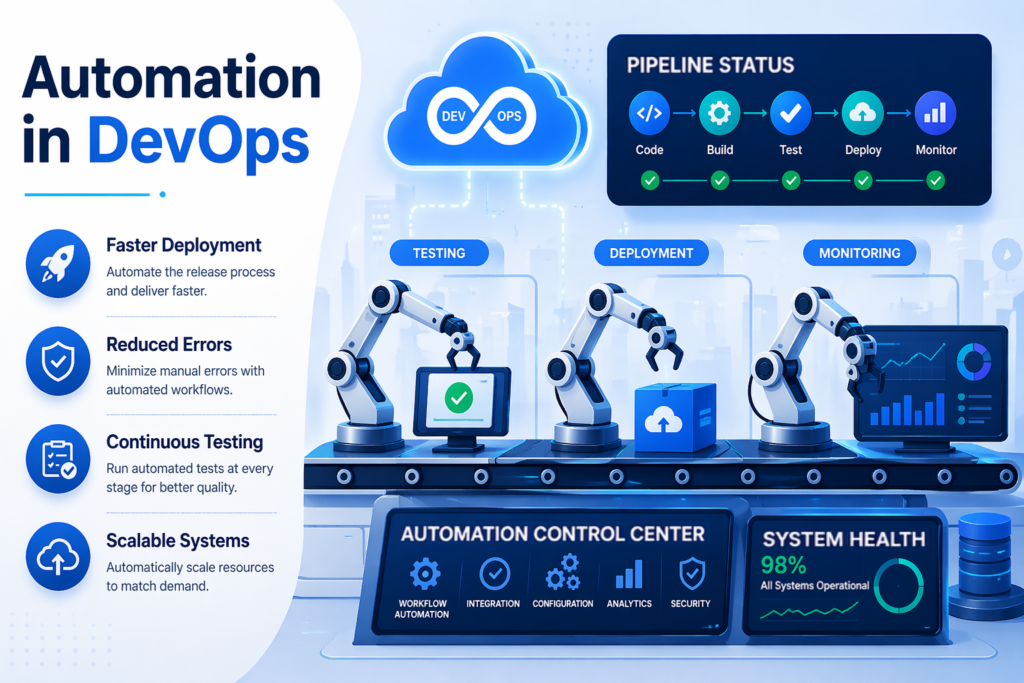
Areas of Automation:
- Code testing
- Infrastructure provisioning
- Deployment processes
- Monitoring and alerts
Automation reduces human error and accelerates workflows. For instance, instead of manually deploying code, automated pipelines handle everything—from build to release.
This significantly enhances the role of DevOps in faster product delivery by eliminating delays and manual dependencies.
3. Infrastructure as Code (IaC)
Infrastructure as Code allows developers to manage infrastructure using code rather than manual processes.
Key Advantages:
- Faster environment setup
- Consistent infrastructure
- Easy scalability
- Version-controlled configurations
Tools like Terraform and AWS CloudFormation make it easier to replicate environments, ensuring that development, testing, and production environments are aligned.
4. Improved Collaboration and Communication
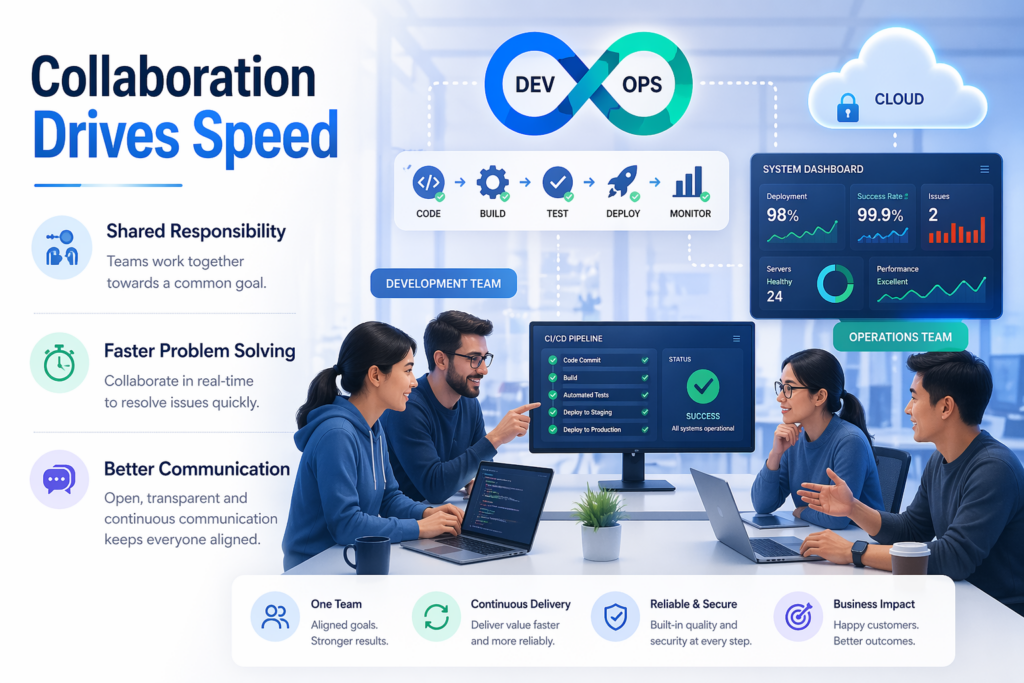
DevOps fosters a culture of shared responsibility.
- Developers and operations teams work together
- Faster issue resolution
- Better alignment of goals
This collaboration eliminates communication gaps and ensures that everyone is aligned with the product delivery timeline.
To understand how collaborative workflows impact modern development, you can explore insights on modern software development practices.
5. Continuous Monitoring and Feedback
Monitoring is essential for maintaining performance and reliability.
Key Monitoring Practices:
- Real-time application monitoring
- Log management
- Performance tracking
- User behavior analysis
Feedback loops help teams identify issues quickly and improve the product continuously.
DevOps Lifecycle and Its Impact on Delivery Speed
The DevOps lifecycle consists of several stages that work together to accelerate product delivery.
1. Planning
- Define requirements
- Create roadmaps
- Align business goals
2. Development
- Write and manage code
- Version control using Git
3. Build
- Compile code
- Integrate components
4. Testing
- Automated testing ensures quality
- Detect bugs early
5. Release
- Prepare code for deployment
6. Deployment
- Automated deployment pipelines
7. Monitoring
- Track performance and issues
Each stage is interconnected, ensuring a seamless flow from development to deployment.
Popular DevOps Tools That Accelerate Delivery
Choosing the right tools is crucial for implementing DevOps effectively.
CI/CD Tools
- Jenkins
- GitHub Actions
- GitLab CI/CD
Containerization and Orchestration
- Docker
- Kubernetes
Configuration Management
- Ansible
- Puppet
- Chef
Monitoring Tools
- Prometheus
- Grafana
- New Relic
These tools enable teams to automate processes and maintain consistency across environments.
For detailed documentation on container orchestration, refer to the official Kubernetes documentation, a widely trusted resource in the DevOps ecosystem.
Real-World Example: How DevOps Speeds Up Delivery
Consider a company developing a web application without DevOps:
- Manual testing delays releases
- Deployment errors occur frequently
- Communication gaps slow down progress
Now, with DevOps:
- Automated testing ensures quality
- CI/CD pipelines enable frequent releases
- Monitoring tools detect issues early
Result? Faster delivery, better quality, and improved customer satisfaction.
Challenges in Implementing DevOps
While DevOps offers numerous benefits, implementation can be challenging.
Common Challenges
- Resistance to cultural change
- Lack of skilled professionals
- Tool integration issues
- Initial setup complexity
How to Overcome These Challenges
- Invest in training and upskilling
- Start with small, incremental changes
- Choose the right tools
- Foster a collaborative culture
Organizations that overcome these challenges can fully leverage the role of DevOps in faster product delivery.
Best Practices for Successful DevOps Adoption
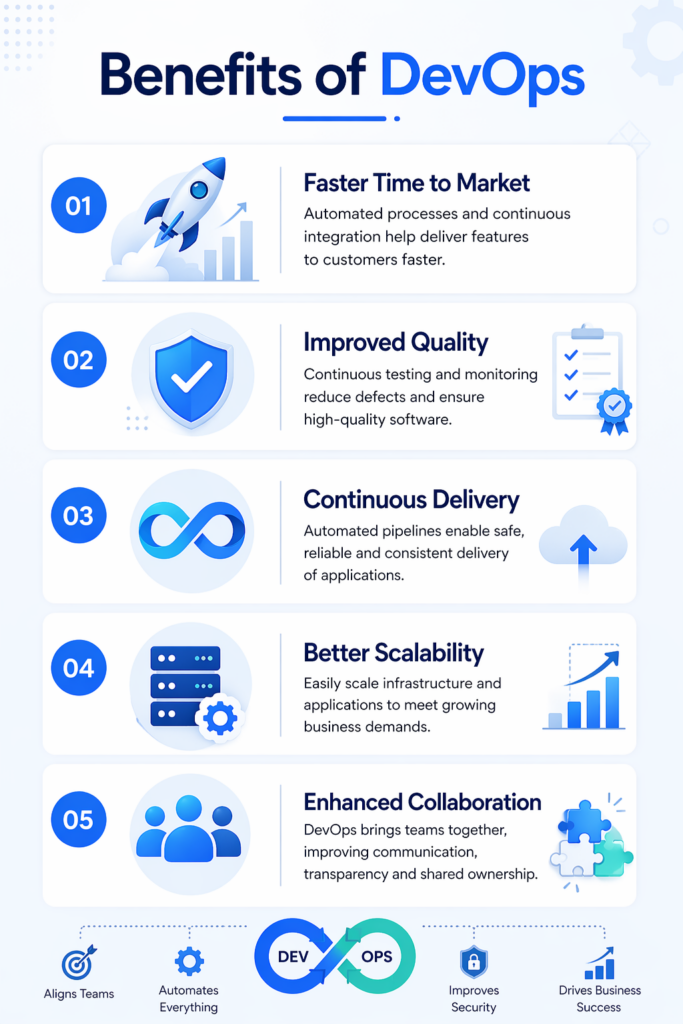
To maximize the benefits of DevOps, organizations should follow proven best practices.
1. Start Small and Scale Gradually
Begin with pilot projects and expand gradually.
2. Focus on Automation
Automate repetitive tasks to improve efficiency.
3. Implement CI/CD Pipelines
Ensure seamless integration and delivery.
4. Use Microservices Architecture
Break applications into smaller, manageable components.
5. Monitor and Optimize Continuously
Use data-driven insights to improve performance.
6. Encourage Collaboration
Build a culture of shared responsibility.
The Future of DevOps in Product Delivery
The future of DevOps is evolving with emerging technologies.
Key Trends
- AI and Machine Learning in DevOps (AIOps)
- Serverless architectures
- Enhanced security (DevSecOps)
- Edge computing integration
These trends will further strengthen the role of DevOps in faster product delivery, making processes more intelligent and efficient.
Conclusion
The role of DevOps in faster product delivery is transformative. It enables organizations to deliver high-quality software quickly, efficiently, and reliably. By adopting DevOps practices such as automation, CI/CD, and continuous monitoring, businesses can significantly improve their development lifecycle.
Moreover, DevOps fosters collaboration, reduces errors, and enhances scalability—making it an essential approach for modern software development.
Organizations seeking to accelerate their digital transformation often rely on experienced partners offering scalable and efficient IT solutions, such as those available through professional IT services, to implement DevOps strategies effectively.
In a world where speed and quality define success, embracing DevOps is no longer optional—it is a strategic necessity.